
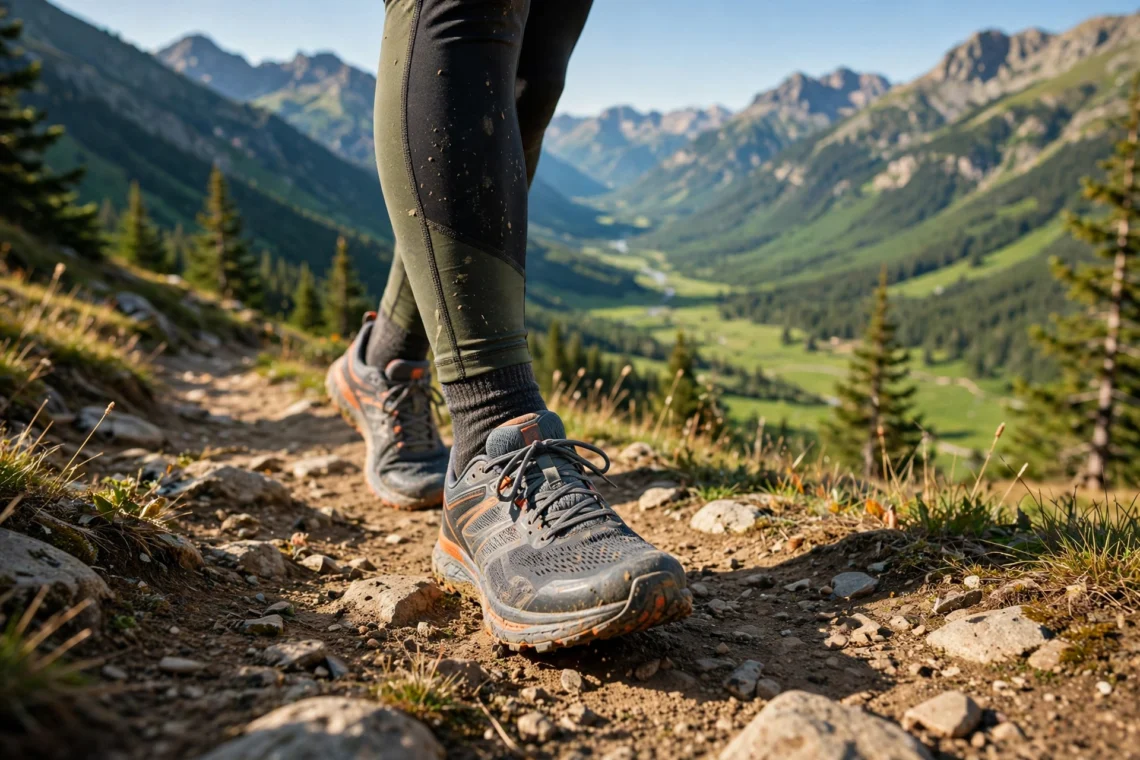
More and more hikers are leaving their boots at home and use trail running shoes for hiking. Walk any popular trail on a summer weekend and you will see them everywhere: light, low-cut shoes with grippy soles, worn by day hikers and thru-hikers alike. Is that a good idea, or a mistake?
This guide gives you the honest comparison with boots, explains when trail runners work and when boots win, covers waterproofing, fit and how to choose — all in one place. There is no single winner. The right footwear depends on terrain, pack weight, weather and your feet. The simple decision rule is this: choose for the hardest conditions you regularly encounter, not the easiest mile at the trailhead.
Quick Answer:
Yes, trail running shoes work for hiking on groomed trails in dry conditions with a light pack under 25–30 lbs. Choose boots instead for heavy loads, technical terrain, snow, or weak ankles.
Quick-Guide Table
| Trip type | Best footwear | Key tip |
| Day hike, maintained trail, light pack | Trail running shoes | Grippy outsole, stable platform, little to no break-in |
| Warm or dry conditions | Non-waterproof trail runners | Mesh drains and dries fast; waterproof traps sweat |
| Heavy pack (over 35 lbs) or technical terrain | Hiking boots | Stiffer sole, toe protection, more structure under load |
| Cold, wet or snowy conditions | Waterproof boots | Membrane helps in cold slush; check crampon needs for ice |
| Mountaineering or ice | Specialized footwear, not trail runners | Ordinary boots alone do not grip ice either |
Helpful List: Choose The Right Shoe In 5 Steps
- Start with your hardest conditions: terrain, pack weight and weather — not the easiest mile at the trailhead
- Pick trail runners for light packs under 25–30 lbs on maintained trails; pick boots for heavy loads or technical ground
- Choose non-waterproof mesh for warm, active hiking; choose waterproof only for cold, slow conditions
- Check fit first: secure heel, roomy toe box, no pinching — try them on and walk around the shop
- Test them on a short hike before a long one, and transition gradually if switching to zero-drop
Can You Hike In Trail Running Shoes?
Yes — for groomed trails, dry conditions, light day packs and day hikes under about 15 miles, trail runners are a genuinely capable hiking option. They are lighter than most boots by a significant margin, require far less break-in, and provide better ground feel on technical terrain. For day hikes under roughly 15 miles with a pack under 25 pounds on established trail, trail runners outperform hiking boots for most hikers.
The type matters. A trail running shoe is engineered for speed and grip on unpaved ground, with aggressive outsole lugs and a flexible midsole. A road running shoe is not a hiking option — it has poor grip off-road, and its smooth outsole slips on dirt, gravel and wet rock. If you are going to hike in a running shoe, it must be a trail running shoe.
The shift is real. More hikers, including thru-hikers covering thousands of miles, now choose trail runners for most of their hiking. That does not make boots obsolete — it means the choice has become a real one, and the right answer depends on your trip. This is not a product review, and no brand is promoted or recommended here. What follows is how to make the decision for yourself.
Trail Running Shoes Vs Hiking Boots: The Honest Comparison
| Feature | Trail running shoes | Hiking boots |
| Weight | 8–12 oz per shoe; about 1 lb to 1 lb 5 oz per pair | Mid boots 14–22 oz per shoe; about 1 lb 8 oz to 2 lb per pair |
| Ankle support | Low cut; relies on your own stability | Higher collar; more coverage and structure |
| Outsole grip | Aggressive lugs; good on dirt and gravel | Very good; stiffer platform for rocky ground |
| Waterproofing | Rarely; some waterproof versions exist | Usually; most models have a membrane |
| Durability | 300–500 miles | 600–1,000+ miles |
| Break-in | Little to none; wear them out of the box | Typically 10–50 miles |
| Pack support | Poor above about 30 lbs | Good under heavy multi-day loads |
Weight is the biggest difference you will feel. A typical waterproof mid hiking boot weighs somewhere between 1 lb 8 oz and 2 lb per pair. Most trail running shoes come in around 1 lb to 1 lb 5 oz. Every pound on your feet costs more energy than a pound on your back, and over a long day that difference is real — it affects your gait, your fatigue and how fresh your legs feel at the end.
Break-in is the second difference. Trail runners need little to none — you can wear them out of the box on a real hike. Boots typically need 10 to 50 miles before they feel right, and a new pair of stiff boots on a long first hike is a reliable way to get blisters.
Durability follows the same pattern in reverse. A quality pair of boots can last 600 to 1,000 miles or more. Most trail runners are showing their age by 400 to 500 miles. Protection is where boots win clearly: they use thicker leather or synthetic uppers, substantial toe caps and stiffer midsoles. Kick a rock in a burly boot and you will barely notice. Do it in a lightweight trail runner and you will remember it for a mile.
The bottom line is that the boot versus trail runner question is not really about footwear categories. It is about load, terrain and weather. Light load, decent trail, warm weather — the trail runner wins. Heavy load, rough terrain, cold or wet — the boot earns its place.
When Trail Runners Are The Better Choice
Trail runners are the better choice on well-maintained trails with no serious off-trail sections: national park visitor trails, state park day hike loops and most popular routes, which are well-graded, clear of major obstacles and designed for the average visitor. On this type of trail, the stiff midsole and ankle collar of a hiking boot adds weight without adding meaningful benefit.
They are the better choice with a pack under 25 to 30 pounds — a hydration pack, a rain layer and lunch. The flexible midsole only starts to fail you when the load it is transmitting to your foot exceeds what the flex can manage, roughly above 25 to 30 pounds.
They are the better choice in warm or dry conditions, or when you prefer wet-fast-dry over waterproofing. In dry weather on non-technical terrain, the grip of a trail running shoe outsole is adequate, and the mesh upper breathes and dries quickly.
They are the better choice for day hikes and weekend trips, fast-and-light missions and thru-hiking, where speed and efficiency matter. And they are the better choice for hikers with strong ankles and solid proprioception — the ability to sense foot position instinctively — on uneven surfaces. Hikers who have spent hundreds of miles on trail develop ankle musculature and awareness that largely replaces the support function a boot collar provides.
If you are only going to own one pair for hiking and you mostly do day hikes, make it a trail running shoe with a grippy outsole and a stable platform.
When To Choose Hiking Boots Instead
Reach for a boot when you are carrying a heavy pack, above about 35 pounds. The extra structure under a heavy load is real, and a flexible trail runner midsole cannot support that weight without your feet working much harder.
Reach for a boot on technical terrain: boulder fields, talus, loose rock and steep scree, where a stiffer sole and toe protection matter. Reach for a boot for extended off-trail travel that requires lateral foot stability, and in cold or persistently wet conditions, or when there is snow on the route.
Reach for a boot if you have ankle instability, previous sprains or hypermobility. A higher collar and stiffer construction give you more coverage and structure when your ankles need it.
One honest note about ankle support: clinical research does not strongly support the idea that high-cut boots prevent ankle sprains. The ligament tears faster than the boot can resist it. What boots do provide is proprioceptive feedback — more sensation of foot position — and reduced micro-instability that causes fatigue over a long day. That is a real benefit, but it is not a guarantee against a sprain. No footwear makes an ankle unsprainable.
Waterproof Or Not? The Gtx Question
Usually, no. Waterproof membranes such as Gore-Tex and similar constructions keep rain out but also trap heat and sweat. On active hiking days where you are working hard and generating heat, your feet often end up wetter from perspiration than they would in a breathable, quick-draining non-waterproof shoe. Standard breathable mesh dries quickly after stream crossings and prevents sweat blisters in warm weather.
Once water gets in over a low collar, waterproof shoes are slower to dry than non-waterproof versions. A waterproof trail runner that has been submerged stays wet longer, because the membrane that keeps water out also keeps it in. For trails that regularly involve mud, creek crossings or sustained rain, a non-waterproof shoe that drains and dries fast is often the more comfortable choice, even in rain.
Waterproof trail running shoes make genuine sense for cold, slow-moving conditions where you are not generating enough heat for sweat to be a factor — snow, cold wet slush, or a slow winter walk. For active hiking, run-and-hike crossover days, or any outing where you are actually working, non-waterproof with good drainage and better flexibility is typically the more comfortable choice. The same logic applies to the best hiking shoes with waterproof membranes: a membrane is a tool for cold and wet, not a default for every hike.
What To Look For In A Trail Runner For Hiking
If you are choosing the best trail running shoes for hiking, start with a durable upper. Hiking drags the foot across rocks more than running does, so a tougher upper lasts longer against lateral abrasion. A thin, light mesh that is perfect for a trail race will tear quickly on a rocky hiking trail.
Look for a rock plate. At a slow hiking pace you spend more time loading the foot on sharp rocks, so underfoot protection is more valuable than it is when you are moving fast. A rock plate spreads the pressure of a sharp stone so it does not bruise the sole of your foot.
Look for appropriate lugs. Around 4 to 5mm handles most maintained trail; deeper 5 to 6mm lugs help in soft, wet or backcountry conditions. Sticky rubber matters too — the outsole compound is what grips wet rock, and not all rubber is equal.
Look for a stable platform and heel lockdown. A secure fit matters more than collar height alone, and a shoe that lets your heel slide will blister you faster than any terrain will. And look for cushioning that holds up over a full day on your feet rather than packing out by mid-afternoon — the foam should still feel supportive at mile ten, not just at mile one.
Fit: Wide Feet, Women’s Fit And Zero-drop
Fit matters most. The question “can I hike in trail running shoes?” is almost always really asking “which trail running shoe fits my foot well enough to hike in comfortably?” A wide-footed hiker in a narrow trail runner will have a miserable day no matter how good the lugs are.
For wide feet, look for a wide toe box that accommodates foot swelling over a long day. Feet swell on long hikes, and a toe box that fits in the shop can pinch by afternoon. If you need the best trail running shoes for hiking with wide feet, the toe box is the feature to check first — more important than the brand or the lug pattern.
For women, the best trail running shoes for hiking in women’s sizing are built on a narrower last, with a different heel and forefoot shape. Try them on, and do not assume a men’s size converts. Your feet are the only judge that matters.
For zero-drop shoes, where the heel and forefoot sit at the same height, transition gradually to avoid calf or Achilles strain. If you have always worn a traditional drop, start with short hikes and build up. And remember: neither choice fixes a bad fit. A roomy boot that lets your heel slide can be less stable than a secure-fitting trail shoe, and an ankle-high collar does not guarantee protection from a sprain.
Are Trail Runners Good For Mountaineering?
The honest answer is no. Ordinary trail runners are not mountaineering footwear. Snow, ice and mountaineering terrain need specialized footwear and traction: cold protection, stiff soles and crampon compatibility matter, and a lightweight mesh trail runner provides none of them.
Ordinary boots alone do not grip ice either. This is a safety warning, not a recommendation: if your route involves snow, ice or mountaineering terrain, you need specialized footwear and traction for the conditions, and you should check the route conditions and your own experience before going. The best trail runners for mountaineering do not exist, because trail runners are not built for that job.
How Long Do Trail Runners Last?
Trail runners typically last 300 to 500 miles of hiking — shorter than traditional leather boots, which often reach 600 miles or more. Because they use lighter foams and meshes, they wear out faster, and that is the honest trade-off for their weight and comfort.
The signs it is time to replace them are worn lugs, compressed cushioning that no longer springs back, torn uppers, and less grip on wet rock. If your shoes feel flat, slip on surfaces they used to grip, or hurt your feet in ways they did not before, they are done.
Rotating two pairs on a long trip spreads the wear and gives each pair time to dry between days, which extends their life. And a note on claims: specific durability figures for individual models are single-source claims from review sites. Do not treat a number like “900+ miles” as a fact — it is one source’s test, not a guarantee.
Common Mistakes To Avoid
The first mistake is wearing road running shoes on a trail. They have poor grip off-road, and their smooth outsoles slip on dirt, gravel and wet rock. The second is choosing waterproof for warm-weather hiking — your feet end up wetter from sweat than they would in a breathable shoe.
The third is buying for the easiest mile at the trailhead instead of the hardest conditions you regularly encounter. Choose for the hardest conditions, not the easiest mile. The fourth is ignoring fit — a narrow shoe on a wide foot, or a loose heel, causes blisters and instability faster than any terrain.
The fifth is switching to zero-drop overnight. Transition gradually, or your calves and Achilles will tell you about it. And the sixth is carrying a heavy pack in a flexible shoe: above about 30 pounds the midsole stops supporting you, and your feet pay for it.
Conclusion
The decision rule is simple. Light load, decent trail, warm weather — trail runners. Heavy load, technical terrain, cold or wet — boots. Trail runners win on weight, comfort and drying speed. Boots win on protection, durability and heavy loads.
Before you commit, try the shoes on, check the fit, and test them on a short hike before a long one. Walk around the shop, climb the stairs, and pay attention to your heel and your toes — they will tell you more than any review can. And if you want to keep planning, the site’s other hiking guides cover the best hiking poles, lightweight hiking shoes, the best backpacking pack and how to pack for a long trip in the same practical style.
FAQ’s:
Can You Hike In Trail Running Shoes?
Yes, on groomed trails in dry conditions with a light day pack under 25–30 lbs. Road running shoes are not suitable — they have poor grip off-road.
Are Trail Running Shoes Better Than Hiking Boots?
It depends on the trip. Trail runners win on weight, comfort and drying speed; boots win on protection, durability and heavy loads. Choose by terrain, pack and weather.
Do I Need Waterproof Trail Running Shoes For Hiking?
Usually no. Waterproof membranes trap heat and sweat on active hikes, and once water gets in over the collar they dry slowly. Choose waterproof only for cold, slow conditions.
How Long Do Trail Running Shoes Last For Hiking?
Typically 300–500 miles, shorter than boots at 600–1,000+ miles. Replace them when lugs wear down, cushioning compresses, or grip on wet rock fades.
Are Trail Runners Good For Mountaineering?
No. Ordinary trail runners are not mountaineering footwear. Snow and ice need specialized footwear and traction, and ordinary boots alone do not grip ice either.
Disclaimer:
This article is for general information only. Trail conditions, weather, prices and gear availability can change, so please check official trail and weather sources before you hike. Travel3Ways is an independent travel information website and is not affiliated with any footwear brand, retailer, tourism board or booking service. Travel3Ways was created only to provide helpful information to visitors and does not engage in paid promotions or advertising.



3 Comments on “Trail Running Shoes For Hiking: When They Work, When Boots Win, And How To Choose”