
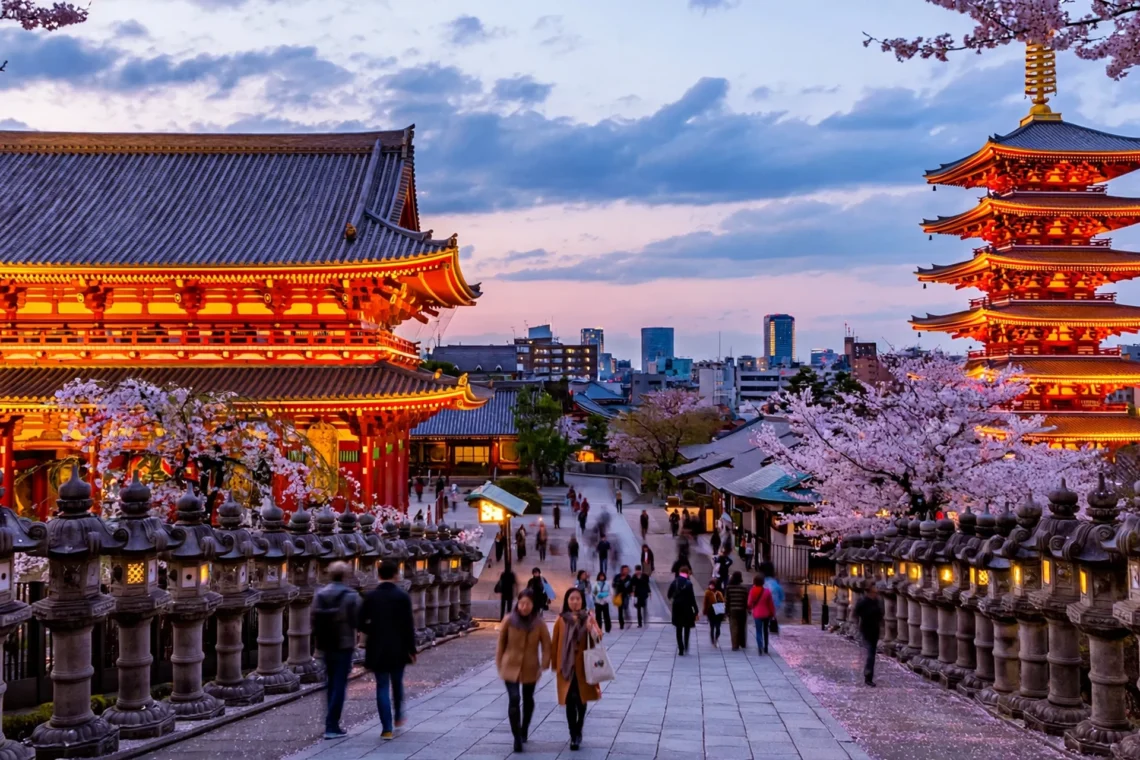
Tokyo is the world’s biggest city, but it is easy to visit if you plan by neighborhood. Three to five days is the right minimum for a first trip — enough to see the old temples, the neon districts, and the food, without rushing from one end of the city to the other. Centuries-old temples and quiet gardens sit next to neon-lit streets, and the trains run on time, which makes the whole city feel far more manageable than its size suggests.
This Tokyo travel guide covers how many days you need, where to stay, how to get around, the top things to do, what to eat, what a trip costs, entry rules, day trips, and a simple four-day plan. There is no PDF or book version of this guide, and forum opinions are not used as facts — everything here is checked against reliable sources.
Quick Answer
Tokyo is best visited in 4 to 5 days, staying near the Yamanote Line in Shinjuku or Shibuya. Use a Suica card for trains, plan by neighborhood, and book teamLab and Shibuya Sky ahead.
Quick-Guide Table
| Trip type | Best places or options | When to go |
| First trip, 4–5 days | Asakusa, Shibuya, Harajuku, Shinjuku, Ginza | March–May or October–November |
| Budget trip | Asakusa hostels, ramen and convenience-store meals, free observatories | Shoulder seasons, avoid cherry-blossom week |
| Cherry blossom | Ueno Park, Shinjuku Gyoen, Meguro River | Late March to early April, follow the forecast |
| Autumn color | Shinjuku Gyoen, Ueno Park, Nikko day trip | Late November to early December |
| Day trip | Kamakura, Nikko, Hakone, Lake Kawaguchiko | Any season; autumn for Nikko, clear mornings for Fuji |
Helpful List : Before You Go
- Check the entry rule for your passport on Japan’s Ministry of Foreign Affairs site.
- Get a Suica or PASMO card on arrival, or add one to your phone before you fly.
- Book teamLab Borderless, Shibuya Sky, and the Ghibli Museum well ahead — they sell out.
- Check the cherry-blossom or autumn forecast if travelling in those seasons.
- Carry some cash — small restaurants, temples, and older shops are often cash-only.
- Set up an eSIM or pocket Wi-Fi before departure.
Tokyo At A Glance
Tokyo spans 23 wards, each with its own character, and there is no single city Center. Asakusa feels like old Japan, Shibuya feels like the future, and Ginza feels like a different world again — and they are all the same city. The trick is to treat each neighborhood as its own small trip, rather than trying to see the whole city at once.
The best time to visit is late March to early April for cherry blossom, or October to November for autumn color. Both seasons are mild and beautiful, but also busy and more expensive, so book early. August is hot and very humid, with a typhoon risk, and it is best avoided if you can choose your dates. Cherry-blossom dates shift every year — in 2026 Tokyo’s first bloom was 19 March and full bloom was 28 March — so follow the forecast rather than planning around a fixed date.
For first-timers, three things are worth knowing before you land. The city is one of the safest big cities in the world. The trains are the main way to get around, and they are clean, frequent, and punctual. And English signs are common in stations and tourist areas, so you will not be lost for long even if you do not speak Japanese.
How Many Days Do You Need In Tokyo?
Three days covers the core loop: old Tokyo in Asakusa, Shibuya and Harajuku, and Shinjuku, plus one paid attraction such as teamLab or Shibuya Sky. It is a busy three days, but it works if you plan by neighborhood and do not try to add day trips.
Four to five days is the right minimum for a first visit. It gives you time for museums, markets, and a slower pace — a morning in a garden, an evening in an izakaya alley, a second look at a neighborhood you liked. This is the length most first-timers are happiest with.
Six to seven days lets you add a day trip — Kamakura, Hakone, or Nikko — and a second neighborhood to explore properly. If you have a week, Tokyo stops feeling like a checklist and starts feeling like a place you know.
Do not try to see everything in two days. Tokyo rewards a slower pace, and a rushed trip mostly means time spent on trains rather than time spent in the city.
Where To Stay In Tokyo
Shinjuku is the best all-rounder and the main transport hub. Shinjuku Station is one of the busiest in the world, with JR, subway, Narita Express, and buses to Hakone, Mount Fuji, and Nikko. It has the widest choice of hotels in Tokyo, from hostels to five-star towers, and you can reach almost anywhere in the city from here.
Shibuya is the best choice for first-timers who want energy. The Scramble Crossing is outside the station, Harajuku and Omotesando is a short walk away, and the streets stay lively late into the evening. It suits travellers who plan to be out at night and want to walk back to the hotel.
Asakusa is old Tokyo, and the best-value area in the city. Senso-ji Temple, the Nakamise shopping street, and the Sumida River give it an atmosphere the rest of Tokyo has mostly lost. It has some of the city’s best hostels and budget hotels, and it goes quiet after 8 p.m., which some travellers prefer.
Ueno is the best area for families. It has direct Skyliner access to Narita airport, and Ueno Park — with its museums, zoo, and cherry blossom — is right by the station. Ginza and Marunouchi suit luxury travellers and food lovers: polished streets, refined restaurants, and the Imperial Palace and Tsukiji Outer Market nearby. They are quiet at night, which is a plus after a long day.
The rule that matters most: stay within a 10-minute walk of a Yamanote Line or major subway station. A hotel five minutes from the station will make every day easier than a nicer one fifteen minutes from the nearest train.
Getting Around Tokyo
The first thing to do on arrival is get a Suica or PASMO IC card — physical or on your phone. It is a rechargeable smart card that covers JR trains, the metro, the subway, buses, and even convenience-store payments, all with one tap. Standard Suica cards have been sold again since March 2025, and Welcome Suica (valid 28 days, no deposit) is available at the airports.
The JR Yamanote Line is the loop that matters most. It circles central Tokyo in about an hour, linking Tokyo Station, Ueno, Akihabara, Shinjuku, Shibuya, and Ikebukuro. Most of the places a first-timer wants to see are on or near this loop, and the Tokyo Metro’s nine lines and the Toei Subway’s four lines fill in everywhere else.
Tokyo has two main airports. Haneda (HND) is closer to the city — about 20 to 30 minutes by monorail or the Keikyu Line. Narita (NRT) is further out, taking 45 to 60 minutes on the Narita Express or the Keisei Skyliner. Check the current fare on the operator’s site before you travel, since fares change.
The JR Pass is not worth it for a Tokyo-only trip. The seven-day nationwide pass costs around ¥50,000, and it only pays off with long shinkansen trips such as Tokyo to Kyoto or Hiroshima. For Tokyo alone, pay per ride with your IC card — a subway ride costs roughly ¥180 to ¥330, and a day of travel is usually under ¥1,000. Taxis are expensive, with a base fare around ¥500, so use trains except late at night.
Top Things To Do In Tokyo
This is an editorial selection of the best first-trip experiences, not a ranked list. Each one is worth your time, and together they cover the city’s two sides: old and new.
Senso-ji Temple in Asakusa is Tokyo’s oldest Buddhist temple, with the great red Kaminarimon lantern gate and a 250-metre shopping street, Nakamise, lined with snack stalls. Arrive before 8:30 a.m. or after 5 p.m. for quiet, illuminated grounds. Meiji Shrine, next to Harajuku, is a peaceful forest shrine in the middle of the city — a good morning walk before the crowds. The Imperial Palace East Gardens are free, quiet, and a pleasant break from the city’s noise.
Shibuya Scramble Crossing is the world’s busiest pedestrian crossing, and it is best seen from above: Shibuya Sky, the open-air rooftop deck 229 meters up, gives you the full view. Book timed-entry tickets online well ahead, especially for sunset slots. In Shinjuku, the Tokyo Metropolitan Government Building has free observatories on the 45th floor, with views across the city — and a free nightly projection-mapping show on the building itself.
Harajuku and Takeshita Street are the heart of Tokyo’s youth culture: colorful shops, crepe stands, and street fashion. Akihabara is the electronics and anime district, worth an evening wander even if you do not buy anything. Tsukiji Outer Market is the place for a morning food walk — go before 9 a.m. for fresh nigiri, tamagoyaki, and matcha along the market lanes.
Two paid attractions are worth booking ahead: teamLab Borderless, a digital art museum where the rooms change around you (roughly ¥3,600 to ¥5,600 depending on the slot), and Tokyo Skytree, the city’s tallest tower. The Ghibli Museum also sells out weeks ahead — book as early as you can. The free attractions — Senso-ji, Meiji Shrine, the Imperial Palace East Gardens, and the Shinjuku observatories — cover most of what people fly here for, and they cost nothing.
Tokyo’s Best Neighborhoods To Explore
Asakusa and Yanaka are the traditional side of Tokyo: historic temples, riverside walks, and old wooden streets that survived the city’s rebuilding. Yanaka, just north of Ueno, still feels like a small pre-war town, with craft shops and quiet lanes.
Shibuya and Harajuku are the energetic side: youth culture, shopping, and the famous crossing, with Omotesando’s tree-lined boulevard a short walk away. Shinjuku has skyscrapers and gardens side by side — Shinjuku Gyoen is one of the city’s best parks — plus Golden Gai, a maze of tiny bars, and the free observatories.
Ginza is polished and calm: wide boulevards, flagship shops, refined sushi counters, and the Tsukiji Outer Market nearby. Akihabara is the opposite — loud, bright, and full of electronics, anime, and gaming culture. Organizing your days by neighborhood saves transit time and lets you feel each area properly, rather than hopping across the city all day.
What To Eat In Tokyo
Tokyo has more Michelin-starred restaurants than any other city, but the best food for most visitors is far simpler. Ramen is the classic first meal: counter shops where you order from a ticket vending machine at the entrance, eat at the counter, and leave. A bowl costs roughly ¥900 to ¥1,200, and it is some of the best food in the city.
Sushi is the other essential. Conveyor-belt sushi is a good first try — cheap, fun, and easy without Japanese. For a special meal, an omakase counter in Ginza or Shibuya is worth it, but book ahead: the best counters fill up weeks in advance.
Izakaya alleys are where Tokyo eats at night. Spend an evening grazing on yakitori skewers, gyoza, and karaage in lantern-lit lanes like Shinjuku’s Omoide Yokocho or Shibuya Yokocho. Department-store food halls — depachika — are worth a visit too: the underground floors of stores like Isetan Shinjuku or Ginza Mitsukoshi sell pristine bento boxes, wagyu, and seasonal sweets.
Tsukiji Outer Market is the best morning food walk in the city. Go before 9 a.m. for the freshest stalls, and come hungry. Omakase counters need booking ahead, while ramen shops and izakaya are walk-in friendly — which is part of their charm.
Best Day Trips From Tokyo
Kamakura is the easiest day trip: temples, the Great Buddha, and a relaxed coastal town, an easy half-day or full day by train from central Tokyo. It is a good choice if you want a break from the city without a long journey.
Nikko is a full day and best in autumn. Its shrines are among Japan’s most beautiful, set in mountain forest with waterfalls nearby. Hakone is the hot-springs option: Lake Ashi, mountain views, and — on clear days — Mount Fuji on the horizon. The Mount Fuji area around Lake Kawaguchiko gives the closest Fuji views, and it is best on a clear morning, when the mountain is most likely to be visible.
For any day trip, check train times in advance and whether a regional pass makes sense for the route. Some day trips are cheaper with a pass, others are cheaper paying per ride — it depends on the route.
How Much Does A Tokyo Trip Cost?
Tokyo’s reputation for being expensive is only half true. A bowl of ramen costs ¥900 to ¥1,200, a subway ride costs ¥180 to ¥330, and many of the best experiences are free. The weak yen has made Tokyo cheaper than most visitors expect, though prices change, so check before booking.
Budget travellers spend roughly $65 to $100 per person per day: a hostel or capsule hotel, convenience-store meals, and IC card transit. Mid-range travellers spend roughly $150 to $250 per day: a business hotel, restaurant meals, and paid attractions. Comfort travellers — luxury hotels, omakase dinners, private experiences — spend $350 a day and up, with no real ceiling.
As a rough guide, teamLab Borderless costs roughly ¥3,600 to ¥5,600 depending on the time slot, and Shibuya Sky costs roughly ¥2,700 to ¥3,400, with sunset slots the most expensive and the first to sell out. Accommodation is the biggest cost: budget hostels run roughly ¥3,000 to ¥7,000 a night, business hotels ¥12,000 to ¥25,000, and luxury hotels ¥40,000 and up, with prices rising sharply in cherry-blossom season.
Entry Rules, Money, And Connectivity
Citizens of around 70 countries and regions — including the US, UK, EU states, Canada, and Australia — can visit Japan visa-free for short stays, usually up to 90 days. Check the rule for your passport on Japan’s Ministry of Foreign Affairs site before booking, since rules differ by nationality and can change.
Visit Japan Web lets you pre-fill immigration and customs forms before arrival and show a QR code at the airport. It is optional — paper forms still work — but it speeds things up. One warning: Japan passed the law creating JESTA, an ESTA-style pre-travel authorization, in May 2026, but the system is not running and is not required. It is aiming for launch in fiscal 2028, and no application portal or fee exists — treat any site selling a JESTA today as fraudulent.
The departure tax rose from ¥1,000 to ¥3,000 per departure on 1 July 2026, and it is collected in your airfare, so you will not pay it separately. For money, cards work widely in Tokyo, but carry some cash: small restaurants, temples, and older shops are often cash-only, and you will want yen coins for temple offerings. For connectivity, set up an eSIM or pocket Wi-Fi before departure — free Wi-Fi in the city is patchy.
Safety Tips And Common Mistakes
Tokyo is one of the safest big cities in the world, but standard precautions still apply: watch your belongings in crowds, especially at stations and crossings. The emergency numbers are 110 for police and 119 for ambulance and fire.
A few points of etiquette will make your trip smoother. Tipping is not expected in Japan — do not leave a tip. Keep quiet on trains, and do not take phone calls in the carriage. Do not eat while walking in crowded areas. Remove your shoes where asked, such as in temples, ryokan, and some restaurants.
The common mistakes are easy to avoid. Do not buy a JR Pass for a Tokyo-only trip — it will cost more than pay-per-ride. Do not try to see everything in two days. Do not visit teamLab or Shibuya Sky without booking ahead — both sell out. Do not expect every restaurant to take cards. And do not plan cherry blossom around a fixed date — the bloom shifts every year.
If an earthquake happens, stay calm, follow staff instructions, and check official advice. Japan is well prepared for earthquakes, and buildings and trains are designed for them.
A Simple 4-day Tokyo Itinerary
Day one is old Tokyo: start at Senso-ji Temple in Asakusa, walk Nakamise street, then spend the afternoon in Ueno Park and its museums, and finish the evening in Akihabara. Day two is west Tokyo: Meiji Shrine and Yoyogi Park in the morning, Harajuku and Takeshita Street at midday, then Shibuya Crossing and Shibuya Sky at sunset.
Day three is central Tokyo: the Imperial Palace East Gardens in the morning, Ginza for lunch and shopping, Tsukiji Outer Market in the afternoon, and teamLab Borderless in the evening. Day four is Shinjuku and your choice: Shinjuku Gyoen in the morning, the free observatories at the Tokyo Metropolitan Government Building, and Golden Gai in the evening — or swap the day for a trip to Kamakura.
Keep the plan loose. One neighborhood per half-day, with time to wander, is better than a packed schedule. Tokyo’s best moments are often the unplanned ones: a side street, a small shrine, a ramen shop you found by accident.
Conclusion
Tokyo is best enjoyed by neighborhood, with four to five days, a base near the Yamanote loop, and an IC card in your pocket. That is the whole plan, and it works: pick an area, stay near a station, and let each neighborhood show you a different side of the city.
Before you go, check three things: the entry rules for your passport, advance bookings for teamLab and Shibuya Sky, and the cherry-blossom or autumn forecast if you are travelling in those seasons. Those three checks will save you more trouble than anything else.
Pick one area to stay, plan by neighborhood, and leave time to get lost in the side streets. That is where Tokyo is at its best.
FAQ’s:
How Many Days Do You Need In Tokyo?
Four to five days is the right minimum for a first visit. Three days covers the core sights, and six to seven days leaves room for a day trip to Kamakura or Nikko.
Do I Need A Visa To Visit Tokyo?
Citizens of around 70 countries, including the US, UK, EU, Canada, and Australia, enter Japan visa-free for up to 90 days. Check the rule for your passport before booking.
Is The JR Pass Worth It For Tokyo?
No, not for a Tokyo-only trip. The seven-day pass costs around ¥50,000 and only pays off with long bullet-train trips, such as Tokyo to Kyoto or Hiroshima.
What Is The Best Area To Stay In Tokyo?
Shinjuku is the best all-rounder, with the most transport links and hotels. Shibuya suits first-timers who want energy, and Asakusa is best for budget stays and old Tokyo.
How Much Does A Tokyo Trip Cost?
Budget travellers spend roughly $65 to $100 per person per day, mid-range travellers $150 to $250, and comfort travellers $350 or more, excluding flights.
Disclaimer
This article is for general information only, and travel conditions, prices, entry requirements, and opening times can change, so please check official travel advice and official sources before you travel. Travel3Ways is an independent travel information website and is not affiliated with any tourism board, airline, hotel, or booking service, and it was created only to provide helpful information to visitors and does not engage in paid promotions or advertising.




2 Comments on “Tokyo Travel Guide: How To Plan Your First Trip, From The Old City To The Neon Streets”