Japan mixes hyper-modern cities, ancient temples and quiet mountain trails in one trip — and it is easier to travel than most first-timers expect. The trains run on time, the streets are clean, the food is wonderful at every price, and English signage in the big cities makes getting around far simpler than the language barrier suggests. A little planning goes a long way here, and this japan travel guide holds everything a first trip needs: the best places, the best time to go, what it costs, how the trains work, where to stay, what to eat and a 10-day itinerary you can copy or adapt.
Prices in this guide are ranges only, and entry rules change, so check official sources — the Japan National Tourism Organization and Visit Japan Web — before you book. Start with the glance table, then the three big cities, then transport, costs and the itinerary.
Quick Answer
Japan’s best first trip covers Tokyo, Kyoto and Osaka in 7–10 days, with Hakone in between. Go in late March–May for cherry blossom or October–November for autumn foliage, and use bullet trains with an IC card.
Quick-Guide Table
| Trip type | Best places or options | When to go |
| First trip (7 days) | Tokyo, Kyoto, Osaka | Late March–May, October–November |
| Classic trip (10 days) | Tokyo, Hakone, Kyoto, Osaka | Late March–May, October–November |
| Longer trip (14 days) | Add Hiroshima, Hokkaido or Okinawa | May–June, September–October |
| Food lovers | Osaka, Tokyo, Fukuoka, Hokkaido | Year-round |
| Nature and hiking | Kamikochi, Hakone, Nikko, Hokkaido | June–August, October–November |
| Winter and snow | Hokkaido (Niseko), Kyoto, Nikko | December–February |
Helpful List: Plan Your First Japan Trip In 5 Steps
- Pick your trip length: 7 days for the big three, 10 days with Hakone, 14 days with Hiroshima or Hokkaido
- Check your passport validity and complete Visit Japan Web registration before arrival
- Do the JR Pass maths for your route — buy it online only if your bullet train fares beat its price
- Book stays 3–6 months ahead for spring and autumn, and book your ryokan first
- Carry ¥10,000–20,000 cash and buy a data eSIM before departure for maps and train navigation
Best Time To Visit Japan
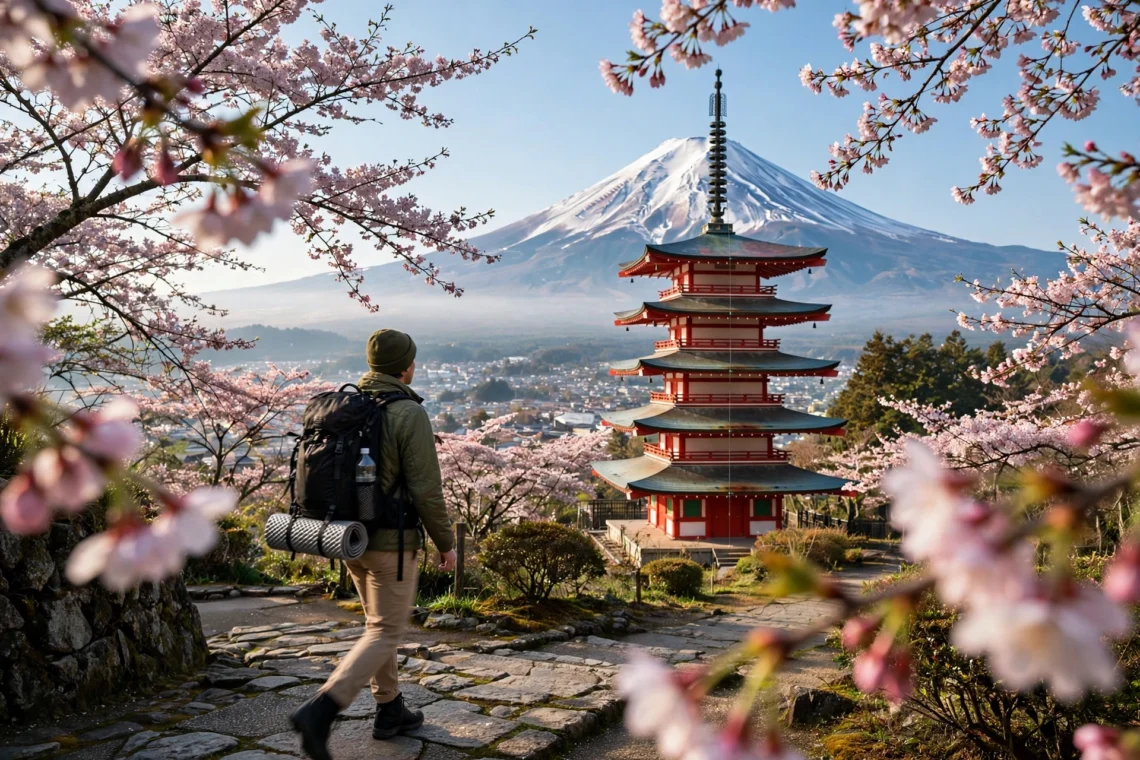
Spring, from late March to May, is the most famous season. Cherry blossoms start in Kyushu in late March and sweep north to Hokkaido by mid-May, with Tokyo and Kyoto at their best in late March and early April. Temperatures sit around 15 to 20°C, parks fill with hanami flower-viewing picnics, and the country looks its prettiest. It is also the most crowded and expensive season — book stays three to six months ahead, and avoid Golden Week, 29 April to 5 May, when domestic travel explodes and trains, hotels and sites are packed.
Autumn, October to November, is the other peak window, and many repeat visitors call it the best season. The foliage turns from late September in Hokkaido to late November in Kyoto, the air is crisp, the skies are clear, and temperatures are comfortable. Kyoto in mid-November, when the temple gardens turn gold and crimson, is among the most beautiful sights in Asia.
Summer, June to August, starts with the rainy season in June, then turns hot and humid, with temperatures often above 30°C and typhoon risk until September. It is the prime window for alpine trekking and summer fireworks festivals, and Mount Fuji’s climbing season runs through it — but casual sightseeing is far less enjoyable in the heat. Winter, December to February, is the quietest and cheapest season. Snow in Kyoto and Nikko is magical, temples operate year-round, and Hokkaido’s ski resorts, particularly Niseko, offer world-class powder. The best months overall are late March to May and October to November.
Tokyo: What To See And Do
Tokyo is best explored neighbourhood by neighbourhood, because each one feels like a different city. Start in Asakusa, the old temple quarter, with Senso-ji, Tokyo’s oldest temple, and the shopping street leading to it. Then cross to Shibuya for the famous scramble crossing and the youth culture of its streets, and to Shinjuku for skyscrapers, department stores and late-night dining alleys. Meiji Jingu, a shrine in a wooded park, and Harajuku’s fashion streets sit side by side in the middle of the city, and Akihabara is the place for electronics and manga culture, while Ueno holds museums and a park, and Yanaka keeps an old-Tokyo feel of quiet lanes and small shops.
For something modern, the teamLab digital art museums are worth an evening — immersive light and sound installations that feel unlike anything else in the city. Day trips are easy: Nikko for ornate shrines and waterfalls, Kamakura for temples, the Great Buddha and the coast, and Mount Takao for a forest hike with Fuji views on a clear day.
Allow at least four full days in Tokyo, ideally five or six on a first visit. The tip that matters most: explore one neighbourhood at a time, and do not try to cross the city three times a day.
Kyoto: Japan’s Cultural Heart
Kyoto was Japan’s imperial capital for over a thousand years, and it still holds around 1,600 temples and roughly a third of the country’s national treasures. The essential sights are Fushimi Inari, with its thousands of vermilion torii gates climbing a forested hillside — go at 6 or 7 in the morning or after 5 in the evening to beat the tour groups — Kinkaku-ji, the Golden Pavilion, Kiyomizu-dera with its wooden terrace, and the Arashiyama Bamboo Grove, which you should reach at opening, 8:30 in the morning, before the crowds arrive.
The quieter picks reward the effort: Tofuku-ji for autumn foliage, Nanzen-ji for its aqueduct and gardens, and the Philosopher’s Path, a canal-side walk between Ginkaku-ji and Nanzen-ji that is at its best in cherry blossom season. Gion’s preserved wooden streets and traditional tea houses are worth an evening walk, when the lanterns come on and the lanes go quiet.
Plan three full days minimum in Kyoto; five is not too much if temples and traditional culture interest you. The practical tip: temples open early, and the first hour of the day is the quietest you will ever see them.
Osaka And Beyond: Food, Day Trips And Nature
Osaka is Japan’s food capital and its most unpretentious big city — louder, friendlier and better for street food than almost anywhere else in the country. Dotonbori is the neon-lit strip where it all happens: takoyaki (octopus balls), okonomiyaki (savoury pancakes) and kushikatsu (deep-fried skewers on sticks). Osaka Castle is photogenic, though its interior is a museum rather than an authentic castle. The real reason to visit Osaka is to eat, and two or three days is plenty.
From Kyoto and Osaka, day trips are simple. Nara, with its deer park and the giant Buddha at Todai-ji, is an easy half-day. Kobe is worth a visit for its harbour and food, and Himeji Castle, Japan’s finest surviving castle, is a short train ride away.
Hakone and Mount Fuji sit between Tokyo and Kyoto and make a natural stop on the way. Hakone offers lake cruises, a mountain ropeway, the open-air art museum and ryokan inns with private onsen baths — a good place to slow down for a night. For nature and trails, Kamikochi in the Japanese Alps is one of the country’s great mountain valleys, the Nakasendo post towns between Magome and Tsumago make a beautiful historic walk, and the Kumano Kodo pilgrimage paths cross forested mountains in the south. Beyond the big three, Hiroshima, Hokkaido for skiing and Okinawa for island beaches all reward a longer trip.
How To Get Around Japan
The shinkansen, Japan’s bullet train network, is one of the world’s great transport achievements. Tokyo to Kyoto takes about 2 hours 15 minutes on the Nozomi, and Tokyo to Osaka about 2 hours 30 minutes. The trains are punctual, clean and comfortable, and they make multi-city trips easy.
The Japan Rail Pass (JR Pass) covers JR trains nationwide, including most shinkansen lines, for 7, 14 or 21 consecutive days. A 7-day ordinary pass costs around ¥50,000, after a significant price increase in late 2023 — so do the maths for your specific itinerary before buying. It only pays for itself with multiple long-distance rides: a Tokyo–Kyoto round trip alone is about ¥27,940, so a single return does not cover the pass. JR Pass holders can now ride the fastest Nozomi and Mizuho trains, but an additional supplement ticket is required, which reduces the pass’s value. Regional passes often offer better value for a trip focused on one area. Buy the pass online before arrival, and activate it at any JR station.
For city travel, download a digital Suica or Pasmo IC card to your phone’s wallet. It works tap-and-go on subways, buses and even convenience store purchases, and it covers the city transport the JR Pass does not. For luggage, use takuhaibin — luggage forwarding — through hotel front desks or convenience stores to ship bags overnight between accommodations for a modest fee, rather than hauling heavy suitcases onto crowded bullet trains.
How Much Does A Trip To Japan Cost?
Japan has a reputation for being expensive, but the weak yen in 2026, hovering around ¥150 to $1, has made it significantly more affordable for visitors from the US and Europe. Daily budgets as ranges only, excluding international flights: budget travelers can manage on about $80 to $120 per person per day, mid-range comfort runs about $170 to $270, and luxury trips run $400 or more.
Where the money goes is simple: stays, food, transport and entry fees. Hostels and capsule hotels run about ¥2,000 to ¥6,000 per night, business hotels more, and ryokans the most. Food can be very cheap — convenience store meals and casual restaurants run about ¥2,000 to ¥3,500 a day — or very expensive at a kaiseki dinner. Transport depends on whether the JR Pass pays for itself on your route.
Carry cash: many small shops, ramen counters, temples and rural buses are cash-only, so keep ¥10,000 to ¥20,000 with you. 7-Eleven and Japan Post ATMs reliably accept US cards. One small cost to know about: Tokyo, Kyoto, Osaka and Fukuoka all charge a small per-night accommodation tax, typically ¥100 to ¥1,000 — check it at booking so it does not surprise you.
Where To Stay: Hotels, Ryokans And Capsules
Business hotels are the best value for most travelers: clean, small, well located and reliably comfortable, usually near a station. They are not luxurious, but they are exactly what a day of walking needs at the end of it.
Ryokans, traditional inns with tatami rooms, futon bedding, multi-course kaiseki dinners and onsen baths, are the most memorable stay in Japan — and the one to book earliest. Top ryokans and boutique hotels often open reservations three to six months ahead and fill quickly during spring and autumn, so book the ryokan first and build the trip around it.
Capsule hotels and hostels are the budget options, around ¥2,000 to ¥6,000 per night, and they suit solo travelers well. Where you stay matters more than the star rating: near a station in Tokyo, and near Gion or the station in Kyoto. For onsen etiquette, wash thoroughly before entering the communal bath, wear no swimwear, and note that tattoos may be restricted at some onsen — ask in advance or look for tattoo-friendly facilities.
What To Eat In Japan
Everyday food in Japan is excellent at every price. Ramen, sushi, convenience store meals and set lunches cover most days well, and a konbini — a convenience store — sells food good enough to plan a meal around. In Osaka, eat the street food: takoyaki, okonomiyaki and kushikatsu along Dotonbori. In Kyoto, try kaiseki, tofu dishes and matcha sweets.
Regional food is worth planning around too: Hokkaido for seafood and ramen, Hiroshima for its own style of okonomiyaki, Fukuoka for tonkotsu ramen. Eating tips: many restaurants are cash-only, look for a ticket machine at the entrance where you order and pay before sitting down, and remember there is no tipping in Japan — the price on the menu is the price you pay.
A 10-day Japan Itinerary
Days 1 to 4 in Tokyo: Asakusa and Senso-ji, Shibuya and Shinjuku, Meiji Jingu and Harajuku, plus a day hike up Mount Takao for forest trails and Fuji views.
Days 5 to 6 in Hakone: ride the mountain switchback train and ropeway, visit the Hakone Open-Air Museum, and unwind overnight in a traditional ryokan with multi-course kaiseki dining.
Days 7 to 9 in Kyoto: walk the torii gates at Fushimi Inari early, explore Higashiyama’s historic lanes, and take a day trip to Nara.
Day 10 in Osaka: spend your final day sampling street food in Dotonbori before departing via Kansai International Airport — an open-jaw flight, arriving in Tokyo and leaving from Osaka, saves backtracking.
Adapt it to your time: seven days means Tokyo, Kyoto and Osaka only, with no Hakone stop. Fourteen days adds Hiroshima, Hokkaido or Okinawa. This is a sample route, not a fixed schedule — move days to fit your pace, and leave one afternoon free in each city for the thing you discover by accident.
Safety, Etiquette And Common Mistakes To Avoid
Japan is among the safest countries in the world for travelers, with very low crime and a culture of honesty — lost items are routinely handed in. Normal precautions still apply, and you should check official travel advice before departure, but most visitors find Japan safer than home.
Etiquette matters more than most travelers expect, and the rules are simple. Do not tip anywhere — it is not practiced and can cause confusion or discomfort, because service is included and expected. Remove your shoes when entering homes, ryokans, some restaurants and temple interiors; look for the step up or the shoe rack at the entrance. Keep your voice low on trains — phone calls on trains are considered very rude, so set your phone to silent. Do not eat while walking on the street. Queue orderly; jumping a queue is extraordinarily rude. A slight bow when greeting or thanking someone is universally appreciated.
Chopstick rules are worth knowing: never stick chopsticks upright in rice, and never pass food directly chopstick-to-chopstick — both are associated with funeral rites. The common mistakes are easy to avoid: buying a JR Pass without doing the maths for your route, skipping cash, visiting Fushimi Inari or Arashiyama at midday, booking Golden Week without knowing what it is, and trusting one “best” ranking without checking what it suits. Stay connected by buying a data eSIM before departure, so you have maps and train navigation from the moment you land.
Conclusion
The simple rule is this: Tokyo for energy, Kyoto for culture, Osaka for food — plus Hakone or the mountains for nature — and the trains connect it all. That is the whole trip in one sentence, and it works.
Seven days covers the big three. Ten days adds Hakone and a ryokan night. Fourteen days adds Hiroshima, Hokkaido or Okinawa. Whichever length you choose, check entry rules, JR Pass prices and travel advice on official sources before booking, and book your stays early for spring and autumn. Then go — Japan rewards the travelers who plan a little and wander a lot. If you want to keep planning, the site’s other destination guides cover Lisbon, Italy, Costa Rica, Mexico, Thailand and places to visit out of the US in the same practical style.
FAQ’s:
Do Us Citizens Need A Visa To Visit Japan?
No. US citizens can visit Japan visa-free for up to 90 days for tourism, with a passport valid for the stay and a return ticket.
How Much Does A Trip To Japan Cost?
Budget travelers spend about $80–120 a day, mid-range about $170–270 a day, and luxury $400 or more, excluding international flights.
Is The Jr Pass Worth It In 2026?
Only if your bullet train fares beat its price — a 7-day pass costs around ¥50,000, while a Tokyo–Kyoto round trip is about ¥27,940.
What Is The Best Time To Visit Japan?
Late March to May for cherry blossom and October to November for autumn foliage, with mild weather and the best scenery of the year.
Do You Tip In Japan?
No. Tipping is not practiced in Japan and can cause confusion — service is included and the menu price is the price you pay.
Disclaimer
This content is for general information only. Travel conditions, prices, entry requirements and opening times can change, so please check official travel advice and official sources before you travel. Travel3Ways is an independent travel information website and is not affiliated with any tourism board, airline, hotel or booking service. Travel3Ways was created only to provide helpful information to visitors and does not engage in paid promotions or advertising.