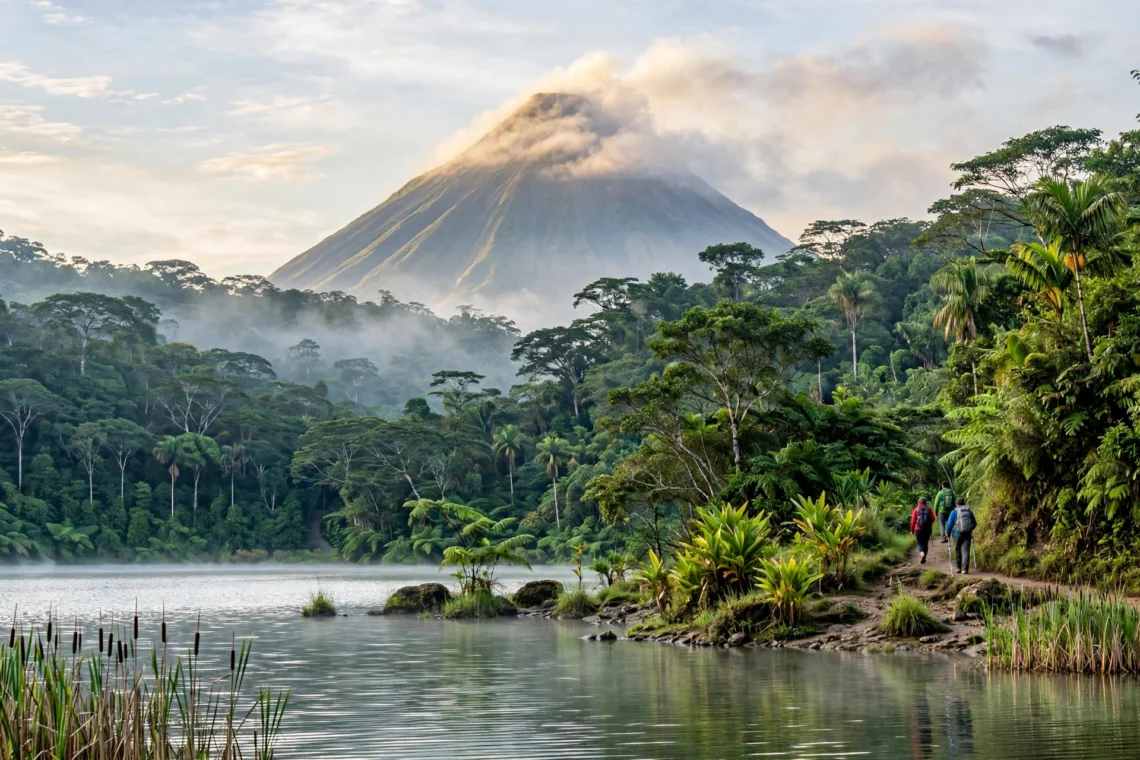
Costa Rica is a small country with an unusually big variety of trips inside it. In one week you can stand in front of a volcano, walk through a misty cloud forest, watch monkeys from a white-sand beach, and surf on the Pacific. On the other side of the country, the Caribbean coast moves at a slower pace, with different food, music, and beaches.
The local phrase is “pura vida”, which means pure life. You will hear it everywhere, as a greeting, a thank you, and a way of looking at life. It fits Costa Rica well, because travel here is rarely rushed. People take time for coffee, for nature, and for conversation.
This Costa Rica travel guide is for first-time visitors and for travelers planning a return trip. It covers the best places to visit, the best time to go, how to get around, what a trip costs, two simple itineraries, and the safety checks to do before you book. By the end, you should be able to plan your whole trip from this one guide.
Quick Answer
Costa Rica is a Central American eco-tourism destination with volcanoes, cloud forests, and beaches on two coasts. The best trip visits two or three regions, such as Arenal, Monteverde, and Manuel Antonio, in seven to ten days.
Quick-Guide Table
| Trip type | Best places or options | When to go |
| Volcano and adventure | La Fortuna and Arenal | December to April |
| Cloud forest and wildlife | Monteverde, Corcovado | December to April, or May to June |
| Beach and national park | Manuel Antonio, Tamarindo | December to April |
| Caribbean coast | Puerto Viejo, Tortuguero | February to March, or September to October |
| First trip | Arenal and Manuel Antonio | December to April, or shoulder season |
Helpful List: Plan Your Costa Rica Trip In 5 Steps
- Choose two or three regions that match your interests — do not try to see the whole country in one trip.
- Pick your season by coast — dry season for the Pacific, September to October for the Caribbean.
- Fly into San José for central and southern regions, or Liberia for Guanacaste.
- Book park tickets, stays, and tours early in the dry season.
- Check entry rules, money, packing, and official travel advice before you book.
Costa Rica At A Glance
Costa Rica sits in Central America, between Nicaragua to the north and Panama to the south. The capital is San José, in the Central Valley. The official currency is the Costa Rican colón, though US dollars are widely accepted in tourist areas.
The country has two coastlines. The Pacific coast is longer and more developed, with surf towns, beach resorts, and national parks. The Caribbean coast is shorter and quieter, with Afro-Caribbean culture, coral reefs, and rainforest.
Most international travelers fly into one of two airports. Juan Santamaría International Airport, known as SJO, is near San José and is the main gateway for the central and southern regions. Daniel Oduber Quirós International Airport, known as LIR, is in Liberia in the northwest and is closer to Guanacaste and the Nicoya Peninsula.
Costa Rica is best known for eco-tourism. A large share of the country is protected in national parks and reserves, and wildlife is a central part of almost every trip. Sloths, toucans, monkeys, and sea turtles are not rare sightings here. They are part of everyday travel.
Before you plan, look at a map and check the distances. Costa Rica looks small, but the roads are winding, mountainous, and often slow. A drive that looks like two hours on a map can take four. That is why most travelers choose two or three regions for a trip, rather than trying to see everything at once. Seven days is enough for two regions. Ten days allows three.
When Is The Best Time To Visit Costa Rica?
Costa Rica has two main seasons, and the right one depends on what you want from your trip.
The dry season runs roughly from December to April. On the Pacific coast and in the Central Valley, this is the sunniest time of year. It is the best time for beach days, volcano views, hiking, and visiting national parks. It is also peak season. Popular places are busier, hotels cost more, and tours and park tickets can sell out, especially around Christmas, New Year, and Easter.
The green season, also called the rainy season, runs roughly from May to November. A typical day starts sunny, with clouds building in the afternoon and rain in the late afternoon or evening. The landscape turns vivid green, waterfalls run strong, and wildlife is very active. There are fewer crowds and lower prices. May, June, and November are often the sweet spot, with green scenery, reasonable prices, and mornings that are usually dry enough for activities.
The Caribbean coast follows a different pattern. It does not have a clear dry season, and rain can fall at any time of year. Its relatively drier stretches are usually February to March and September to October. That last period is useful to know, because September and October are the wettest months on the Pacific side, when some lodges on the Osa Peninsula close and dirt roads can become difficult.
There is no single best month for the whole country. Choose your season by coast and by activity. For Pacific beaches, choose the dry season. For lush rainforest and lower prices, choose the green season. For the Caribbean, consider September and October.
10 Best Places To Visit In Costa Rica
Costa Rica has many regions, but these ten cover the best of the country for most travelers.
La Fortuna and Arenal is the adventure capital. The cone-shaped Arenal Volcano rises above the town, and the area offers hot springs, waterfalls, hanging bridges, and hiking through old lava fields. It suits families, couples, and adventure lovers.
Monteverde is a misty highland region famous for its cloud forest. Low clouds drift through moss-covered trees, and the reserve is one of the best places in the country for birdwatching. Canopy ziplining and night walks are popular here. It suits nature lovers who do not mind cool, damp weather.
Manuel Antonio is a small national park on the Central Pacific coast where rainforest meets white-sand beaches. Sloths, monkeys, and iguanas are easy to spot on the trails, and the beaches are some of the most beautiful in the country. It suits first-time visitors and families.
Tamarindo and Guanacaste offer dry, sunny beaches and surf towns in the northwest. Tamarindo is lively, with restaurants, shops, and consistent waves. Nearby beaches are quieter. This region suits beach lovers and surfers.
Puerto Viejo on the Caribbean coast is slower and more colorful. The food, music, and culture are Afro-Caribbean, and the beaches near town are good for surfing and relaxing. It suits travelers who want a different side of Costa Rica.
Corcovado National Park and the Osa Peninsula are remote and wild. Corcovado is known for having some of the highest wildlife diversity in the country, including tapirs and big cats, though sightings are never guaranteed. It suits serious wildlife enthusiasts who are happy to travel far and stay in simple lodges.
Tortuguero National Park on the northern Caribbean coast can only be reached by boat or small plane. Its canals are best explored by boat, and it is famous for sea turtle nesting. It suits travelers who want a true jungle experience.
San José, the capital, is usually a one-night stop rather than a main destination. The Central Market, the National Museum, and the coffee scene are worth a short visit before heading to nature.
Santa Teresa and the Nicoya Peninsula offer consistent surf, yoga, and a relaxed beach lifestyle. Santa Teresa has one of the strongest surf cultures in the country and draws experienced surfers year-round.
Uvita on the South Pacific coast is known for Marino Ballena National Park and its whale-tail sandbar, visible at low tide. It is quieter than Manuel Antonio and suits travelers who want beaches without crowds.
Best Place To Visit In Costa Rica For First Time
If this is your first trip to Costa Rica, the best choice is usually La Fortuna and Arenal, or Manuel Antonio. Both pack a lot into one compact area, which is ideal when you have limited time.
La Fortuna is the better choice if you want adventure. You can hike near the volcano in the morning, visit a waterfall in the afternoon, and soak in hot springs in the evening, all without long drives. The town has plenty of hotels, restaurants, and tour operators, so planning is easy.
Manuel Antonio is the better choice if you want beaches and wildlife together. The national park is small enough to explore in half a day, and the beaches are right there. You can see monkeys and sloths in the morning and spend the afternoon swimming. The area is also easy to reach from San José.
If you have to choose only one, pick by trip type. Choose La Fortuna for adventure and volcano views. Choose Manuel Antonio for beaches and easy wildlife. If you have a week, choose both. They are different enough to feel like two trips in one.
What you should avoid on a first trip is trying to see the whole country. Costa Rica rewards slow travel. Two regions done well are better than five regions rushed through.
How To Get Around Costa Rica
Getting around Costa Rica takes planning, because the country is bigger than it looks and the roads are slow.
If you fly into San José, you are close to the Central Valley, Arenal, Monteverde, and Manuel Antonio. If you fly into Liberia, you are close to Guanacaste, Tamarindo, and the Nicoya Peninsula. Choose your airport by your first region, not just by flight price.
A rental car gives you the most freedom, especially for rural beaches and mountain roads. An SUV with high clearance or four-wheel drive is a good idea if you plan to drive to Monteverde or to remote beaches, where roads can be steep and unpaved. Rental cars in Costa Rica also require insurance, so check what is included before you book. Do not drive at night if you can avoid it. Roads are often unlit, with potholes, sudden washouts, and animals crossing.
Shared tourist shuttles connect the main hubs, such as San José, Arenal, Monteverde, and Manuel Antonio. They are door-to-door, air-conditioned, and reliable, though more expensive than buses. Public buses are the cheapest option and reach almost everywhere, but they are slow and indirect. They are a good choice for budget travelers who have time.
Domestic flights save hours on long routes, for example from San José to the Osa Peninsula or Tortuguero. They are expensive and have strict luggage limits, so they suit travelers who are short on time.
Whatever you choose, plan to arrive at your destination before sunset. Travel times run longer than the map suggests, and arriving in daylight makes everything easier.
Where To Stay In Costa Rica
Costa Rica has stays for every style, from simple guesthouses to luxury eco-lodges. The best choice depends on your region and your budget.
In La Fortuna, stay near the town for restaurants and tours, or in a lodge with volcano views if you want a quieter stay. In Monteverde, stay in the village of Santa Elena or in a lodge near the reserve, and be ready for cool, misty mornings. In Manuel Antonio, stay near the park entrance for easy access to the trails and beaches, or in Quepos town for lower prices. In Tamarindo, stay near the beach for surf and restaurants. In Puerto Viejo, stay in a small guesthouse or cabina near the beach for a local feel.
Eco-lodges are a big part of Costa Rica travel. Many are in or near rainforest, with wildlife right outside your room. They are often more expensive, but they include nature that you would otherwise pay for as a tour.
Book early in the dry season, especially around Christmas, New Year, and Easter. Hotels and tours in popular areas can fill up months ahead. In the green season, you will have more choice and often lower prices, and you can sometimes book a day or two ahead.
What To Eat In Costa Rica
Costa Rican food is simple, fresh, and filling. The best place to eat is a soda, a small family-run restaurant that serves local food at local prices.
The most common dish is the casado, a plate of rice, beans, salad, plantain, and meat, chicken, or fish. It is the everyday lunch for many Costa Ricans, and it is a good, cheap way to eat well. For breakfast, try gallo pinto, a mix of rice and beans served with eggs, cheese, and coffee. Costa Rica is also known for its coffee, grown in the highlands around the Central Valley.
On the Caribbean coast, the food is different. Rice and beans are cooked in coconut milk, and you will find fresh seafood, plantain, and spices that reflect Afro-Caribbean culture. In beach towns, fresh fish and seafood are common, and fruit is everywhere.
Food costs vary by place. A meal at a soda is much cheaper than a meal at a tourist restaurant. A rough guide is that a local lunch costs far less than a dinner in a resort area, but prices change, so use ranges rather than fixed numbers when you budget. Eating where locals eat is not only cheaper. It is also one of the best ways to understand a place.
How Much Does A Trip To Costa Rica Cost?
Costa Rica is the most expensive country in Central America, so it helps to plan your budget honestly.
Costs are usually described in three rough groups, excluding international flights. Budget travel, roughly $50 to $90 per person per day, is possible if you stay in hostels or guesthouses, eat at sodas, and use public buses. Mid-range travel, roughly $100 to $250 per person per day, covers comfortable hotels, some guided tours, and meals at a mix of local and tourist restaurants. Luxury travel, $400 and up per person per day, covers eco-lodges, private drivers, and high-end tours.
The biggest costs are usually accommodation, tours, and transport. Guided tours, park fees, and shuttles add up quickly, especially if you do a tour every day. A rental car is also a major cost, including insurance and fuel.
You can save money in a few reliable ways. Travel in the green season for lower hotel prices and fewer crowds. Use public buses instead of private shuttles where you have time. Eat at sodas and markets instead of tourist restaurants. Choose one or two special activities, such as a night walk or a boat tour, rather than booking everything. Many beaches and viewpoints are free, and they are often the best part of a trip.
Prices change, so treat any number as a guide, not a promise. Check current prices with the hotel, tour operator, or park before you book.
Costa Rica Itinerary: 7 Days And 10 Days
A good itinerary in Costa Rica is built around two or three regions, with travel time included. Here are two simple plans that work well for first-time visitors.
7-day itinerary: Arenal and Manuel Antonio
Days 1 to 2: Arrive in San José, drive to La Fortuna. Spend two days around Arenal, with a volcano hike, a waterfall, hanging bridges, and hot springs.
Days 3 to 4: Drive to Monteverde or stay longer in Arenal. If you choose Monteverde, spend a day in the cloud forest reserve and a morning on a zipline or hanging bridges.
Days 5 to 7: Drive to Manuel Antonio. Spend a day in the national park, a day on the beach, and your last morning in Quepos before returning to San José.
10-day itinerary: Arenal, Monteverde, and Guanacaste
Days 1 to 3: Arenal and La Fortuna, as above, with time for hot springs and a coffee or chocolate tour.
Days 4 to 5: Monteverde, with a cloud forest walk, a night walk, and birdwatching.
Days 6 to 10: Drive to Guanacaste. Spend the last days in Tamarindo or a quieter beach town, with surf lessons, a sunset boat trip, and a day to rest.
If you want to add the Caribbean coast or the Osa Peninsula, add at least two or three extra days. Both are far from the main route, and the journey itself takes most of a day. Do not try to add them to a seven-day trip.
Leave one day in your plan with nothing fixed. It gives you room for weather, for a place you fall in love with, or simply for rest.
Entry Rules, Money, And Packing
Entry rules for Costa Rica depend on your nationality, so check with an official source before you book. Many visitors can enter without a visa, but you will need a valid passport and proof of onward or return travel. Immigration decides the length of your stay on arrival, so do not assume a fixed number of days from a blog. Check the Costa Rican embassy or official tourism site for your nationality.
For money, the official currency is the Costa Rican colón. US dollars are widely accepted in tourist areas, but paying in colones often gives you a better exchange rate. Carry some cash in colones for small restaurants, buses, and markets. Cards are accepted in most hotels and larger restaurants, but not everywhere.
For packing, bring light, quick-dry clothes, because you will sweat on hikes and get wet in rain. Bring rain gear in every season, not just the green season, because rain can fall in the mountains at any time. Bring closed shoes for hiking, sandals for the beach, bug spray, sunscreen, and a reusable water bottle. Tap water is generally safe to drink in most tourist areas, but if you are unsure, ask your hotel or buy bottled water.
Pack light if you are moving between regions. You will be loading and unloading bags often, and small planes and shuttles have luggage limits.
Safety Tips For Costa Rica
Costa Rica is considered one of the safest countries in Central America, and most visitors have a trouble-free trip. The main risk is petty theft, not violent crime, especially in tourist areas.
Never leave bags visible in a rental car, and do not leave valuables unattended on a beach. Use a hotel safe where one is available, and carry only what you need for the day. In San José, avoid walking alone at night in quiet streets, and use a taxi or rideshare after dark.
At the beach, check local advice about rip currents before you swim. Conditions vary by beach, and some Pacific beaches have strong currents. Look for beach flags and ask locals or lifeguards if you are unsure. Never swim alone in a remote area.
For health, mosquito protection matters, especially in rural and coastal areas. Use repellent and wear long sleeves in the evening. Check official health advice before you travel, and make sure your travel insurance covers medical care and, if needed, evacuation from a remote area.
These are general precautions, not reasons to avoid Costa Rica. With common sense and a little planning, it is a safe and welcoming country to visit.
Common Mistakes To Avoid In Costa Rica
The most common mistake is trying to see too much in one trip. Costa Rica looks small, but drives are long and slow. Two or three regions in a week is enough. Five regions in a week means most of your trip is spent in a car.
The second mistake is booking without checking the season for your specific coast. The Pacific and Caribbean coasts have almost opposite patterns. A trip that is perfect for the Pacific in September can be very wet, while the Caribbean is at its best.
The third mistake is not booking national park tickets in advance. Manuel Antonio and Arenal require advance booking in high season, and tickets can sell out. Check the official park site before you go.
The fourth mistake is only visiting the famous places. Corcovado, Tortuguero, and Uvita are less known, but they offer wildlife and beaches that the famous parks do not. If you have time, add one quieter place to your plan.
The fifth mistake is forgetting hidden costs. Park fees, transfers, and tours are not included in your hotel price. Add them to your budget before you book, so there are no surprises.
Avoiding these mistakes is simple. Plan slowly, check the details, and leave room in your schedule.
Conclusion
Costa Rica gives you a lot in one trip: volcanoes, cloud forests, beaches on two coasts, and wildlife that is easy to see. You do not need to visit every region to have a good trip. You need to choose two or three that match what you enjoy, and give them enough time.
Start with your interests, then your budget and your dates. Choose the season that fits your coast and your activities. Book your flights, stays, and park tickets early in the dry season, and check entry rules and safety advice with official sources before you travel.
Pura vida is not just a phrase. It is a reminder to slow down and enjoy the trip you have planned. Choose your regions, pack your rain gear, and start planning.
FAQ’s:
When Is The Best Time To Visit Costa Rica?
The best time is December to April for Pacific beaches and volcano views, with more crowds and higher prices. May to November is greener and cheaper, while September and October are often best on the Caribbean coast.
How Many Days Do I Need In Costa Rica?
Seven days is enough for two regions, such as Arenal and Manuel Antonio. Ten days allows three regions, such as Arenal, Monteverde, and Manuel Antonio or Guanacaste, without rushing between long drives.
Is Costa Rica Safe For Tourists?
Costa Rica is considered one of the safest countries in Central America. The main risk is petty theft, so keep valuables out of sight, check beach flags for rip currents, and avoid walking alone at night in San José.
Do I Need A Visa To Visit Costa Rica?
It depends on your nationality. Many visitors can enter without a visa, but you need a valid passport and proof of onward travel. Check official Costa Rican government sources before booking.
How Much Does A Trip To Costa Rica Cost Per Day?
Costa Rica is the most expensive country in Central America. Budget travel is roughly $50 to $90 per person per day, mid-range is roughly $100 to $250, and luxury is $400 or more, excluding international flights.
Disclaimer
This content is for general information only. Travel conditions, prices, entry requirements, and opening times can change, so please check official travel advice and official sources before you travel. Travel3Ways is an independent travel information website and is not affiliated with any tourism board, airline, hotel, or booking service. Travel3Ways was created only to provide helpful information to visitors and does not engage in paid promotions or advertising.