
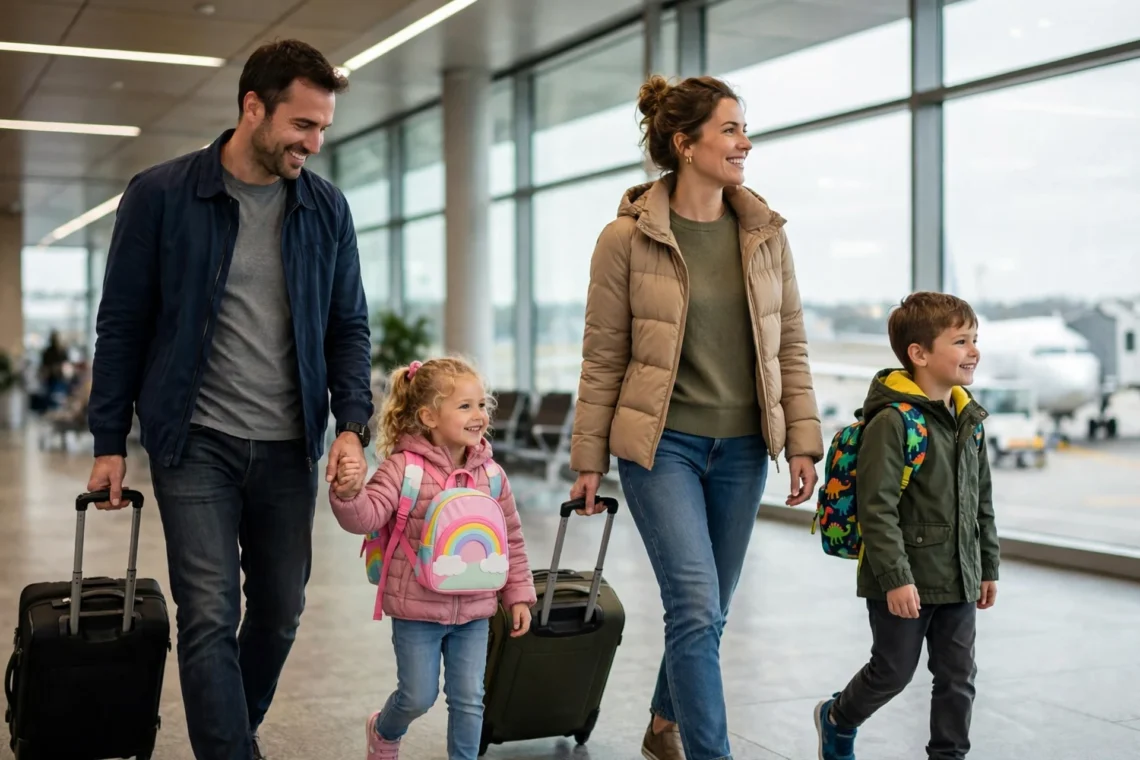
Traveling with kids is not hard because of the destination. It is hard because of the planning, the waiting, and the unexpected moments in between — the delayed flight, the tired toddler at the gate, the nappy that runs out an hour from landing. Parents who travel well with children are rarely the ones with the perfect itinerary. They are the ones who planned for the journey itself, not just the place at the end of it. This guide covers how to travel with kids in a practical way: planning, flights, packing, documents, and safety, for babies, toddlers, and older kids, by plane and by car, for domestic and international trips. It tells you what to check before you book, what to pack, how to handle the journey, and what to do when things go wrong.
Quick Answer
To travel with kids, plan around your child’s age, keep one main activity per day, and pack medicines, snacks, and comfort items in your carry-on. Check passports and airline rules before booking, and allow extra time for everything.
Quick-Guide Table
| Trip type | Best places or options | When to go |
| Flying with a baby | Lap infant or own seat with an approved restraint; bottle at takeoff and landing | After about 2–3 months; match nap times |
| Flying with a toddler | Direct flight; carry-on survival bag; burn energy at the airport first | Early morning or nap-time flights |
| Flying with older kids | Own seat; headphones; rotate activities every 20–30 minutes | Any flight; involve them in the choices |
| Road trip | Proper car seat; stop about every 2 hours; snack bag within reach | Short driving days, not one very long day |
| International trip | Passports for everyone, including babies; check consent rules; travel insurance | Check entry rules weeks before departure |
| Staying overnight | Family suite, connecting rooms, or rental; ask about a crib and fridge | Book family rooms and cribs early |
| Beach or nature day | One main activity; shade, water, and sunscreen; familiar comfort items | Mornings out, midday rest, evenings flexible |
Helpful List: Before You Leave: A Quick Checklist
- Check passports — every traveler needs one for international trips, including babies
- Check your airline’s rules — lap infant age limits, fares, car seat approval, and baggage rules
- Pack the carry-on first — medicines, snacks, comfort item, spare clothes, and entertainment
- Confirm the stay — ask about a crib, a fridge, and laundry before you arrive
- Save copies offline — passports, bookings, insurance, and emergency contacts on your phone
- Check travel insurance — read what it covers for children, medical care, and trip changes
Start With Your Child’s Age, Not The Destination
The first mistake parents make is planning the trip and then fitting the child into it. It works better the other way round. Babies, toddlers, and older kids need different plans, and one approach does not fit all ages.
With a baby, the trip runs on feeding, sleep, and nappies. Days need to be short, with somewhere quiet to feed and change, and a plan for naps that does not depend on a hotel room. With a toddler, the trip runs on movement, snacks, and routine. Toddlers need to walk, climb, and explore, and they cope badly with long waits in one place. With older kids, the trip runs on involvement. Give them simple choices — which toy to bring, which snack to pick, which stop to make — and they feel part of the trip instead of being dragged along it.
On health, waiting until a baby is about two to three months old before flying is generally advised, but treat that as guidance to check with your own doctor, not as a rule. Every baby is different, and a short chat with your doctor before a first flight is worth more than any guide. The rule for this whole article is simple: plan the trip around the youngest traveler’s needs first, and the rest of the plan will follow.
Planning The Trip: Dates, Pace, And One Base
Good family trips start with the calendar. Where you can, avoid the busiest weeks, when airports are full, queues are long, and prices are highest. And whatever dates you choose, allow extra time for everything. With kids, a thirty-minute transfer can take an hour, and a short walk to a restaurant can take twice as long as planned. Building that time in from the start removes most of the stress.
Pace matters more than the number of sights. A useful rule is one main activity a day: schedule one excursion in the morning and keep the afternoon open for rest, pool time, or a playground. Children enjoy a trip far more when they are not rushed from one place to the next, and parents enjoy it more too. Trying to fit three sights into a day with a toddler usually ends with everyone tired and nobody happy.
For families with young children, one base for the week works better than a different hotel every night. Unpacking once, learning the nearest shop and park, and letting the children settle into one room makes the whole week easier. Family rooms, cribs, and popular attractions sell out first, so book those early. And when you choose a place, look for short drives, shade, and child-friendly stops rather than the most famous name on a list. A quiet beach with a playground nearby often beats a famous attraction with a two-hour queue.
What Are The Rules For Flying With A Child?
Flight rules for children confuse many parents, because the airline, the aviation authority, and the airport each have their own part. Start with age. Children under two can usually travel as a lap infant on domestic flights, sitting on an adult’s lap without a ticket. From their second birthday, a child needs their own seat and a purchased ticket. On international flights, a lap infant usually costs around ten percent of the adult fare plus taxes, though the exact figure depends on the airline and the route.
On safety, the Federal Aviation Administration recommends that young children fly in their own seat, secured in an FAA-approved child restraint system, rather than being held on a lap. That is the safest option during turbulence, and it also gives you a defined place for feeding, sleeping, and handling your belongings. Not every car seat is approved for aircraft use, so look for labeling that says the seat is certified for use in motor vehicles and aircraft. Booster seats are not allowed for taxi, takeoff, or landing. The CARES harness, a special harness made only for planes, is an option for children roughly between 22 and 44 pounds, but it is not for infants and it is not safe for car travel.
Airlines may ask for proof of age for a lap infant, so carry a birth certificate or passport for a child under two. And remember that each airline sets its own policies on fares, bassinets, and seating, so check your own airline’s rules before booking. A rule that applied on one airline may not apply on another.
Documents And Consent: What To Check Before You Travel
Documents cause more family travel problems than almost anything else, and most of them are easy to prevent. For international travel, every traveler needs a valid passport, including babies. There is no age exception. Check the expiry rules for your destination on official sources before you book, because some countries require a passport to be valid for months beyond your return date.
For domestic travel in the United States, children under 18 do not need ID at the TSA checkpoint when travelling with an adult. The adult’s ID is what matters, and it must be an acceptable form of identification. That does not mean you should travel without anything for your child, though — a copy of a birth certificate is useful for proving a lap infant’s age to the airline.
One situation needs extra care: a child travelling internationally with only one parent. Some countries and airlines ask for extra documents in this case, and a child travel consent form is one of the documents families are sometimes asked to show. Do not treat this as a formality. Check the official requirements for your destination and your airline well before departure, and carry what they ask for. This guide gives no legal advice and no template — the official source for your route is the only safe place to check.
Keep digital copies of passports, bookings, and insurance saved offline on your phone, and keep printed essentials where you can reach them. And check what your travel insurance covers for children, medical care, and trip changes before you buy it, not after you need it.
Travel With Kids Packing List
Packing for a family trip is really two lists: the carry-on and the checked bag. The carry-on is the survival bag, and it needs the real things. Medicines, wipes, nappies, a comfort toy, snacks, a full change of clothes for each child, and an extra shirt for yourself in case of spills or motion sickness. Anything that would cause real trouble if the checked bag went missing belongs in the carry-on.
The checked bag holds the rest: clothes, nappies and wipes with one extra day’s supply in case of delays, toiletries, and a small first-aid kit. A good rule is to pack more nappies, wipes, and snacks than you think you will need. You would rather carry too many than run out somewhere you cannot buy more.
Two rules make packing easier. First, the favorite toy or blanket goes in the carry-on, never in checked luggage. Losing a child’s comfort item on the first day can spoil the whole trip. Second, bring enough for a few days and buy basics like nappies at the destination where possible, instead of carrying a whole week’s supply. And for sleep, small familiar things help a lot in unfamiliar rooms: a portable white noise machine, a favorite bedtime book, and the child’s usual sleep sack or pillow. Let older kids pack their own small bag, but expect to carry it yourself at some point — they will not carry it the whole time.
Flying With Kids: The Airport And The Flight
The flight itself starts before you board. When you choose a flight, the cheapest is not always the best with kids. A direct flight reduces the rushing between gates with tired children, but on a very long route a planned stop can help children reset, move around, and eat properly. Match the flight time to your child’s natural rhythm where you can — an early morning flight or one that lines up with nap time — but do not build the whole plan around a nap that may never happen.
At the airport, arrive early and let young kid’s burn energy at play areas before boarding, so they are ready to sit still. Use family lanes at security where they are available. Children aged 12 and under go through modified screening, which usually means their shoes stay on, and parents may carry infants through the metal detector. Formula, breast milk, and baby food are exempt from the usual liquid limit, but you must declare them to the security officer. Strollers and car seats are screened too and may need to be folded.
Explain the day to your children in simple steps before you go: taxi, check-in, security, waiting, boarding, takeoff, snacks, landing, and bags. Children cope far better with waiting when they know what comes next. On the plane, offer a bottle, a pacifier, or a chewy snack at takeoff and landing to help little ears adjust to the change in cabin pressure. Rotate quiet distractions every 20 to 30 minutes — a sticker book, a puzzle, a coloring set — instead of handing over everything at once. Download shows and games onto a tablet with kid-safe headphones before you leave home, and relax the normal screen-time rules for travel days. If you are using a car seat on the plane, board early once families are invited, so you have time to fit it properly.
Road Trips With Kids
Road trips have one big advantage over flights: you control the stops. Use it. Keep a road-trip bag within reach with snacks, water, wipes, a change of clothes, and a few favorite toys or books. A sunshade on the window, a backseat organizer, and a proper car seat fitted to your child’s age and size make long drives far more comfortable. Check the car seat’s own instructions for how it should be fitted, and remember that car seat rules for the road are different from aircraft rules, so check both separately.
Stop about every two hours so everyone can stretch, use the restroom, and get fresh air. Look for parks or playgrounds along your route instead of relying only on standard rest stops — a ten-minute run around does more for a child than a longer stop in a car park. For snacks, low-mess finger foods like cheese sticks, crackers, and cut fruit keep hunger at bay without covering the car. Keep plastic bags, wet wipes, and motion-sickness remedies within arm’s reach in the front seat, not buried in the boot. And keep the day’s driving in shorter stretches where you can. A trip with two short driving days is usually happier than one very long one.
Where To Stay And Eat With Kids
Where you stay shapes the trip as much as where you go. Before booking, ask whether the property provides a crib, a high chair, or a fridge, and whether laundry is available. Confirming this in advance saves luggage space and avoids surprises on arrival. For families, a family suite, connecting rooms, or a vacation rental with a separate bedroom works well, because adults can stay awake after early bedtimes without waking the children.
Self-catering often works better for families than several hotel rooms. An apartment or beach house with a kitchen lets you cook simple meals, store milk and snacks, and eat on your child’s schedule instead of a restaurant’s. For eating out, plan meal times around your child’s routine and carry snacks for the gaps. Buy milk or baby food before boarding a flight, since planes rarely carry milk as a drink. Keep the address of your stay and your emergency contacts saved in your phone, and keep a note of the nearest pharmacy and clinic, just in case. This guide recommends no specific hotel or restaurant — the advice is general, and the right place is the one that fits your family’s needs.
Keeping Kids Happy (and Calm) On The Move
The secret to a calm trip is not a clever trick. It is the basics, done steadily. Familiar items, regular snacks and water, and rest when the child is tired rather than pushing through to the next sight. A tired, hungry child cannot enjoy anything, and no attraction is worth a meltdown.
Entertainment works best by age. Toddlers do well with books, simple toys, and things they can hold. Older kids do well with activity books, headphones, and a say in what happens next. Save new items for the hardest part of the journey — the wait at the gate, the middle of a long flight — instead of using them all in the first hour. And be honest with yourself about expectations. Some crying and restlessness is normal on any trip with young children, and no plan removes it completely.
Your own calm matters too. Pack light where you can, accept help from staff when it is offered, and keep the day’s plan loose enough to change. If the morning goes wrong, drop the afternoon plan and let the children play. A flexible day with a happy child beats a full schedule with a miserable one. No product or trick is a guaranteed fix, and anyone who promises one is selling something, not giving advice.
Health, Safety, And Travel Insurance
Health on a family trip is mostly about preparation. Keep essential medicines in hand luggage, in their original packaging, with prescriptions where needed, and check the destination’s rules for carrying them. A small first-aid kit with plasters, a thermometer, and any allergy medicine your child needs is worth its space.
One rule has no exception: never give medicine to make a baby sleep. It is not safe, and it is not a travel tip. If your baby struggles to sleep on a trip, use the familiar sleep cues instead — the usual blanket, the bedtime book, the white noise — and accept that sleep will be lighter away from home.
For sun and heat, use sunscreen, hats, and water, and rest in the shade during the hottest hours, with extra care for babies and young children. Drink safe water, follow local food advice, and keep hand wipes handy. For insurance, choose a policy that covers children, medical care, and trip changes, and read what it covers and what it excludes before buying. This guide gives no medical advice and no health statistics. If your child has a medical condition, talk to your doctor before the trip and carry a short note about it.
Common Mistakes To Avoid When Travelling With Kids
Most family travel problems come from a short list of avoidable mistakes.
Packing the comfort item or the medicines in checked luggage instead of the carry-on is the first. If the bag is delayed, the trip starts badly. Booking the cheapest flight without checking the time, the layover, or the arrival hour is the second. A flight that lands at midnight with a toddler is rarely worth the saving. Planning too much in one day is the third. Without time for rests, meals, and delays, the day falls apart by the afternoon.
Forgetting documents is the fourth: passports for babies, proof of age for lap infants, and consent paperwork for one-parent international trips. Check them a week before departure, not the night before. Skipping travel insurance or choosing bookings you cannot change is the fifth, because trips with children change more often than trips without them. And the last mistake is assuming a plan that worked for one age will work for the next. A baby plan will not work for a toddler, and a toddler plan will not work for a seven-year-old. Update the plan as your children grow, and the trips will keep getting easier.
Conclusion
Travelling with kids works when the plan fits the child’s age, the pace is slow, and the essentials are in the carry-on — not when the itinerary is perfect. A trip with one good activity a day, a familiar blanket, and enough snacks will beat a packed schedule every time. Pick the trip type, check the documents and your airline’s rules, pack the carry-on first, and book the things that sell out early. Then keep the trip simple, leave room for the unexpected, and enjoy it at your child’s pace. That is how a family trip becomes one you all remembering well.
FAQ’s:
What Age Can A Baby Fly?
It is generally best to wait until a baby is about two to three months old before flying, but every baby is different. Check with your doctor before booking your baby’s first flight.
Do Kids Need A Passport To Travel?
Yes, every traveler needs a valid passport for international travel, including babies. For domestic flights in the US, children under 18 do not need ID when travelling with an adult.
Can A Child Under Two Fly On My Lap?
Yes, children under two can usually travel as a lap infant on domestic flights, and international lap infants usually cost around 10% of the adult fare. The FAA recommends an approved child restraint in the child’s own seat instead.
What Should I Pack In The Carry-on For Kids?
Pack medicines, wipes, nappies, snacks, a comfort toy, a full change of clothes, and entertainment in your carry-on. Keep anything essential with you, because checked bags can be delayed or lost.
How Do I Keep Kids Calm On A Flight?
Let young kids burn energy at airport play areas before boarding, and then rotate quiet distractions every 20 to 30 minutes. Offer a bottle or chewy snack at takeoff and landing to help their ears adjust.
Disclaimer
This article is for general information only, and travel conditions, prices, entry requirements, and opening times can change, so please check official travel advice and official sources before you travel. Travel3Ways is an independent travel information website and is not affiliated with any tourism board, airline, hotel, or booking service, and it was created only to provide helpful information to visitors and does not engage in paid promotions or advertising.





One comment on “How To Travel With Kids: A Practical Guide For Calmer Family Trips”