

The United States is too big to see everything in one trip, and every list of landmarks looks different. One list starts with the Statue of Liberty, another with the Grand Canyon, a third with a bridge you have never heard of. The honest truth is that there is no official “most famous” ranking — so this guide picks the famous landmarks of US worth planning a trip around, with their names, where each one is, how long to spend there, and which ones need tickets booked in advance.
The landmarks are grouped by type — historic, architectural, and natural — so you can pick the kind of trip you want. The practical route is simple: choose a regional cluster, or one major city plus one national park, not all of them at once.
Quick Answer:
The most famous landmarks of US are the Statue of Liberty, Grand Canyon, Mount Rushmore, Golden Gate Bridge, National Mall and Niagara Falls. Pick one region per trip and book high-demand tickets early.
Quick-Guide Table
| Landmark | Location | Typical visit | Main planning requirement |
| Statue of Liberty | New York City | 4–6 hours | Reserve ferry; crown and pedestal need separate advance tickets |
| Grand Canyon | Arizona | Half-day to 2 days | Check rim access, weather and shuttle schedules |
| Mount Rushmore | South Dakota | 1.5–3 hours | No entry reservation; parking fee applies |
| Golden Gate Bridge | San Francisco | 1–2 hours | Check pedestrian and bicycle schedules |
| National Mall | Washington, D.C. | 3–6 hours | Individual sites have different rules |
| Niagara Falls | New York | 1–2 days | Boat tours run seasonally |
| Yellowstone | Wyoming/Montana/Idaho | 2–4 days | Check road and geyser-basin access |
| Yosemite | California | 1–3 days | Summer may need reservations |
| Empire State Building | New York City | 1–2 hours | Timed ticket recommended |
| Independence Hall | Philadelphia | 1–2 hours | Timed tickets March–December |
Helpful List: Plan Your Landmarks Trip In 5 Steps
- Pick one region: Northeast and D.C., the Southeast, the Midwest, the West, or Hawaii — do not try to see everything in one trip
- Choose by trip type: natural scenery, history, or architecture — then shortlist 3–5 landmarks
- Book high-demand tickets early: Statue of Liberty crown and pedestal, White House tours, Washington Monument, Alcatraz, USS Arizona Memorial
- Check the official National Park Service or operator site for hours, fees and timed-entry rules before you travel
- Allow realistic time: 4–6 hours for the Statue of Liberty, half-day to 2 days for the Grand Canyon, 3–6 hours for the National Mall
Historic And Cultural Landmarks
The Statue of Liberty and Ellis Island sit in New York Harbor, and they are the most internationally recognizable of all the landmarks of the US. The statue was dedicated in 1886, a gift from France, and stands 151 feet tall on Liberty Island. Take the ferry from Battery Park, allow 4–6 hours for the statue and Ellis Island together, and book crown and pedestal tickets well in advance — the climb to the crown is 363 steps. Ellis Island, on the same ferry, tells the story of the millions of immigrants who arrived through its halls.
The Lincoln Memorial and the National Mall anchor Washington, D.C. The Lincoln Memorial is a neoclassical marble temple honoring President Abraham Lincoln, sitting at one end of the Mall opposite the Washington Monument and the U.S. Capitol. The memorial itself is open 24 hours, and the Mall holds the Washington Monument, the Jefferson Memorial, the Vietnam Veterans Memorial and the Smithsonian museums — plan 3–6 hours for the Mall alone.
Independence Hall in Philadelphia is the red-brick building where both the Declaration of Independence and the U.S. Constitution were debated and signed. Timed tickets are needed from March to December, and the Liberty Bell Centre is a short walk away.
Mount Rushmore National Memorial in the Black Hills of South Dakota shows the 60-foot granite faces of Presidents George Washington, Thomas Jefferson, Theodore Roosevelt and Abraham Lincoln, carved into the mountainside between 1927 and 1941. The memorial was designed to represent the first 150 years of U.S. history, though not everyone celebrates it — the land is sacred to the Lakota Sioux, and the site’s history is worth knowing before you visit. Allow 1.5–3 hours; there is no entry reservation, only a parking fee.
The Alamo in San Antonio is an 18th-century Spanish mission and fortress, famous as the site of the pivotal 1836 Battle of the Alamo. Entry to the church is free, but a reservation is advised in busy seasons. The USS Arizona Memorial at Pearl Harbor in Honolulu honors the sailors lost on December 7, 1941 — book through Recreation.gov, as tickets go quickly.
Architectural And Urban Icons
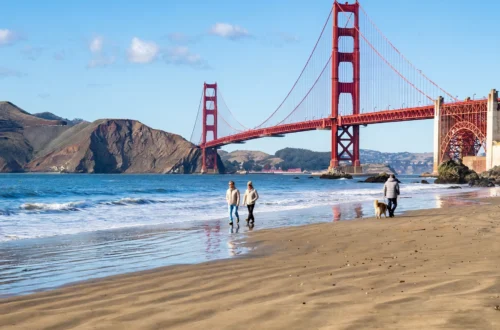
The Golden Gate Bridge in San Francisco is the most photographed bridge in the country. Completed in 1937, it spans more than 4,200 feet across the Golden Gate strait, connecting San Francisco to Marin County, painted in its famous International Orange. Walk it or bike it — the pedestrian side is free, and the views back toward the city are the ones you see on postcards. Fog is common in summer mornings, so go later in the day for the clearest views.
The Empire State Building in New York City was completed in 1931 and remains the defining Art Deco skyscraper of the Manhattan skyline, with 102 stories and observation decks on the 86th and 102nd floors. A timed ticket is recommended, and sunset slots are the most popular.
The Gateway Arch in St. Louis is a 630-foot stainless-steel monument celebrating westward expansion, and it is the tallest arch in the world. A tram ride takes you to the top for views over the Mississippi River and the city. The Space Needle in Seattle is a 605-foot observation tower built for the 1962 World’s Fair, offering views of Puget Sound and Mount Rainier on a clear day.
The Hollywood Sign in Los Angeles is forty-five-foot-tall white letters perched on Mount Lee in the Santa Monica Mountains, symbolizing the American entertainment industry. There is no close access — the best views are from the Griffith Observatory or the Lake Hollywood Park trail. Cloud Gate, known to everyone as “The Bean”, is the reflective stainless-steel sculpture at the center of Millennium Park in Chicago, and it is free to visit at any hour.
Natural Wonders And National Parks
The Grand Canyon in Arizona is the clearest natural counterpart to the Statue of Liberty. Carved by the Colorado River over millions of years, it stretches 277 miles long, up to 18 miles wide, and about a mile deep. The South Rim is the main access, open year-round, and it is where most first-time visitors go. Half a day gives you the viewpoints; two days lets you hike below the rim. Nearly 5 million people visit each year, so arrive early in summer.
Yellowstone National Park, spread across Wyoming, Montana and Idaho, was America’s first national park. It is renowned for geothermal features like the Old Faithful geyser, colorful hot springs, and abundant wildlife — bison, elk and bears roam the valleys. Allow 2–4 days, and check road access before you go, as some roads close in winter.
Yosemite National Park in California’s Sierra Nevada is celebrated for granite cliffs like El Capitan and Half Dome, giant sequoias, and towering waterfalls like Bridalveil Fall. The best time to visit is spring, when the waterfalls are at their fullest, or fall, when the crowds thin out. In peak summer, check the park website in advance — reservations are required for some of the busier days.
Niagara Falls, on the New York side of the U.S.–Canada border, is three massive waterfalls famous for their sheer water volume and mist-filled boat tours. The American side gives you the falls up close; the Canadian side gives you the wide view. Monument Valley, on the Arizona–Utah border within the Navajo Nation, is a dramatic desert landscape of towering sandstone buttes rising up to 1,000 feet — best seen on the 17-mile scenic drive or a guided Navajo tour. The Great Smoky Mountains, on the Tennessee–North Carolina border, is the most-visited national park in the country, and it is free to enter.
These are the beautiful landmarks of the US that most travelers remember longest — not because they are the biggest, but because no photograph prepares you for the scale.
Landmarks By Region — Where To Go First
The Northeast and Washington, D.C. hold the densest cluster: New York City, Philadelphia and Washington, D.C. are a few hours apart by train, and together they cover the Statue of Liberty, Ellis Island, Independence Hall, the National Mall, the White House and the Empire State Building. This is the best region for a first trip if you want history and city landmarks.
The Southeast covers the Alamo in Texas, the Kennedy Space Center in Florida, and the Biltmore Estate in Asheville, North Carolina — a good fit for a road trip with warm weather. The Midwest holds the Gateway Arch in St. Louis, Cloud Gate in Chicago, and Mount Rushmore in South Dakota, which pairs well with the Black Hills and Badlands.
The West is where the natural landmarks live: the Golden Gate Bridge, Yosemite and Yellowstone, the Grand Canyon and Monument Valley. Distances here are long, so pick one area — northern California, or the Southwest — rather than trying to drive between them all. Hawaii holds the USS Arizona Memorial at Pearl Harbor, which pairs with a few days on Oahu.
How To Plan A Landmarks Trip
Do not try to connect all of them on one trip. Choose a regional cluster, or one major city plus one national park. That is the single most useful piece of advice in this guide.
Plan by trip type instead. For natural scenery, start with the Grand Canyon, Yellowstone, Yosemite, Niagara Falls or the Great Smoky Mountains. For U.S. history, priorities the National Mall, the Alamo, Boston’s Freedom Trail, Pearl Harbor and Arlington National Cemetery. For architecture and engineering, choose the Empire State Building, the Golden Gate Bridge, the Space Needle, the Hoover Dam or the Gateway Arch.
The best time to visit is spring and fall for most landmarks — fewer crowds, mild weather, and lower hotel prices. Summer is the busiest season at the national parks, and winter is the best time for desert landmarks like the Grand Canyon’s South Rim, when the crowds are gone and the light is at its best.
Tickets And Advance Booking
Several high-demand sites need advance planning, and this is where most trips go wrong. Book ahead for the Statue of Liberty’s crown and pedestal, White House tours (request 7–90 days in advance), the Washington Monument (timed ticket), Alcatraz in San Francisco (weeks ahead), and the USS Arizona Memorial (through Recreation.gov).
Timed entry applies at the Empire State Building and at Independence Hall from March to December. No booking is needed for the Golden Gate Bridge, the National Mall grounds, the Lincoln Memorial, or Mount Rushmore — though Mount Rushmore charges a parking fee.
Fees and timed-entry systems change often, so confirm everything on the official National Park Service or operator site before you travel. Prices are given as ranges in this guide, never as fixed quotes, because they change by season and by tour type.
Common Mistakes To Avoid
The most common mistake is trying to see everything in one trip. The United States is too big — pick a region and enjoy it properly. The second is not booking high-demand tickets early: the Statue of Liberty crown, the pedestal, Alcatraz and White House tours all sell out, sometimes weeks ahead.
The third is skipping the official site check. Hours, prices and timed-entry rules change often, and a third-party blog from last year will not tell you about this year’s reservation system. The fourth is underestimating distances and drive times between landmarks, especially in the West, where two “nearby” parks can be five hours apart. And the fifth is ignoring weather and seasons — summer crowds at the national parks, and winter closures on mountain roads in Yellowstone and Yosemite.
Conclusion
The landmarks of the US that most travelers remember are the same ones that appear on every list: the Statue of Liberty, the Grand Canyon, Mount Rushmore, the Golden Gate Bridge, the National Mall and Niagara Falls. They earned their fame honestly — each one is worth the trip on its own.
The smart way to see them is to choose a regional cluster, book the high-demand tickets early, and check the official National Park Service pages before you go. Then go — the country is at its best when you slow down and stand in front of one great place at a time. If you want to keep planning, the site’s other US guides cover places to visit out of the US, solo travel, and how to pack for a long trip in the same practical style.
FAQ’s:
What Is The Most Famous Landmark In The USA?
There is no official ranking, but the Statue of Liberty is the most internationally recognizable US landmark. The Grand Canyon is the clearest natural counterpart.
How Many Days Do You Need To See The Main Us Landmarks?
You cannot see them all in one trip. One region takes 4–7 days: New York City and Washington D.C., or the Grand Canyon and the Southwest.
Do You Need To Book Tickets For Us Landmarks?
Some do: the Statue of Liberty crown and pedestal, White House tours, Washington Monument, Alcatraz and the USS Arizona Memorial. Others, like the Golden Gate Bridge and the National Mall, need no booking.
What Is The Best Time To Visit Us Landmarks?
Spring and fall are best for most landmarks — fewer crowds and mild weather. Summer is busiest at national parks; winter suits desert landmarks like the Grand Canyon South Rim.
Is Mount Rushmore Free To Visit?
There is no entry reservation or entry fee, only a parking fee. Allow 1.5–3 hours for the memorial, the trail and the evening lighting ceremony in summer.
Disclaimer:
This article is for general information only. Travel conditions, prices, entry requirements, and opening times can change, so please check official travel advice and official sources before you travel. Travel3Ways is an independent travel information website and is not affiliated with any tourism board, airline, hotel, or booking service. Travel3Ways was created only to provide helpful information to visitors and does not engage in paid promotions or advertising.



One comment on “Landmarks Of Us: The Most Famous Places To Visit, From Coast To Coast”