
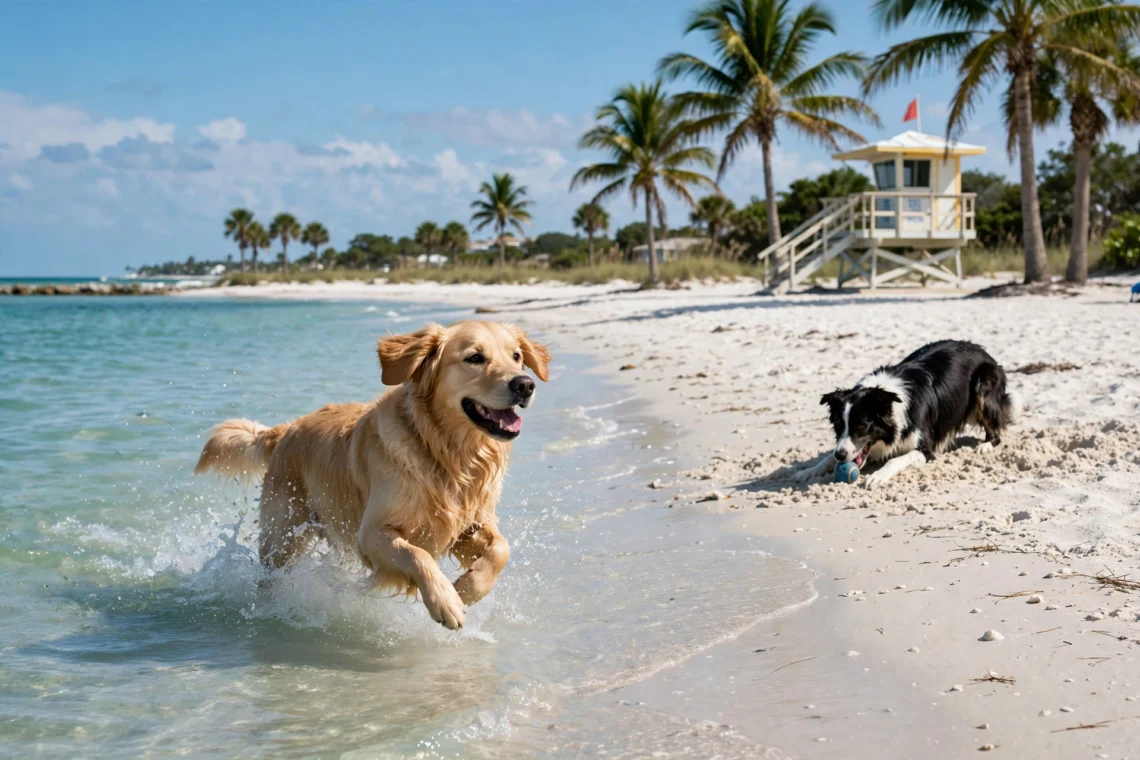
Most Florida beaches ban dogs outright, so a search for dog friendly beaches in Florida usually ends in disappointment. You find a beautiful stretch of sand, drive there with your dog, and discover the “no dogs” sign at the entrance. This guide lists only the beaches where dogs are actually allowed — the best dog friendly beaches in Florida by coast, with the exact leash rule, hours, and entry fee for each.
Beach access in Florida is set at city and county level, not by the state. The rule can change at a street corner, so always check the posted signs and the city or county page before you go. The practical route is simple: pick your coast, check the hours, and pack for the heat.
Quick Answer
Florida has about twenty designated dog beaches, mostly on the Gulf, Atlantic, and Panhandle coasts. The best are Fort De Soto, Jupiter, Honeymoon Island, Walton Rocks, and Pensacola, each with its own leash rule and hours.
Quick-Guide Table
| Trip type | Best places or options | When to go |
| Off-leash beach day | Fort De Soto, Jupiter, Walton Rocks | Early morning or late afternoon, year-round |
| Calm water for first swimmers | Honeymoon Island, Bonita Beach Dog Park | Morning, when the water is calmest |
| A free beach day | Jupiter, Walton Rocks, Canova Beach, Pensacola | Weekdays, early morning, to avoid crowds |
| Panhandle beach trip | Pier Park Dog Beach, Pensacola Dog Beach | May to October, 7am to sunset |
| A beach near Orlando | Smyrna Dunes Park, Canova Beach, Daytona Beach | Early morning, before the heat builds |
Helpful List: Before You Go
- Check the city or county page for the beach’s leash rule, hours, and any permit requirement
- Check Florida Healthy Beaches for water quality and red-tide warnings
- Pack fresh water and a collapsible bowl, shade, a leash, waste bags, and paw protection
- Go early morning or late afternoon to dodge peak heat and crowds
- Test the sand with the back of your hand — if it is too hot for you, it is too hot for your dog
How Florida’s Dog Beach Rules Actually Work
The first thing to understand is that most Florida beaches ban dogs outright. There are roughly twenty designated dog beaches in the whole state, not hundreds of miles of open coast. The good ones are excellent — you just have to know which they are before you drive.
Access is set at city and county level, and the rule can change at a street corner. Clearwater is the clearest example: leashed dogs are allowed north of Somerset Street and banned south of it, on the same beach. A dog-friendly hotel, campground, or beachfront park does not mean the sand in front of it allows dogs.
Florida state parks otherwise ban dogs from beaches outright. Honeymoon Island’s Pet Beach is the rare exception — a designated pet beach inside a state park, and even there the leash rule is strict.
Many dog beaches carry seasonal or time-of-day rules. Jacksonville Beach allows dogs only before 9am and after 5pm from April to September, and any hour from October to March. Cocoa Beach has set hours that follow the clock change. Boca Raton’s Bark Beach needs a permit, a marked stretch, and set hours. Some beaches close sections seasonally to protect nesting sea turtles and shorebirds.
Florida law requires current rabies vaccination and county registration for your dog. Service dogs are allowed on any public beach under the Americans with Disabilities Act. Emotional support animals, comfort animals and therapy dogs are not considered service animals under the ADA, and they are not permitted on beaches that are closed to pets.
Gulf Coast Dog Beaches
Fort De Soto Paw Playground, in St. Petersburg, is widely considered the best dog beach in the state, and it is the only beach in Pinellas County where dogs are allowed at all. Dogs can run off-leash on the sand under voice control, and the park has separate fenced grassy runs for large and small dogs, dog wash stations, and calm white-sand surf. It is open 7am to sunset year-round, and parking is $6 per vehicle. Dogs need a license, tags and current vaccinations, there is a limit of three dogs per person, and the handler has to be at least sixteen and carrying a leash. Dogs must be leashed entering and exiting the area.
Honeymoon Island State Park Pet Beach, in Dunedin, sits at the southern tip of the island, with shallow, wave-free water that is ideal for wading. The important detail is that it is on-leash only — a six-foot handheld leash at all times, with no off-leash access. Entry is $8 per vehicle, and the park is open 8am to sunset, every day of the year.
Bonita Beach Dog Park, in Fort Myers Beach, is off-leash with free parking and canine showers. The Gulf water here is calm and shallow, with sandbars at low tide — though wading through knee-deep water may be required to reach the sandbar during high tide. A leash is required between the parking lot and the sand.
Davis Islands Dog Beach, in Tampa, is off-leash and free. Tampa quietly runs a second one at Picnic Island that almost no roundup mentions. One thing to do before you go: both have a history of bacteria advisories, including a no-contact advisory in early 2025. Check Florida Healthy Beaches the morning of your trip.
Atlantic Coast Dog Beaches
Jupiter Off-Leash Dog Beach is the largest dog-friendly stretch in Florida, running two and a half miles from dune crossover 26 north to 57. Well-behaved, non-aggressive dogs can run off-leash under voice control along a clean, wide Atlantic shoreline, with free parking, complimentary waste bags, and rinsing stations.
Walton Rocks Beach, in Jensen Beach, is an off-leash beach park that sprawls over 24 unspoiled coastal acres, with plenty of room to roam, fresh-water rinse hoses, restrooms, and shaded picnic pavilions. Canova Beach Park, in Indian Harbour Beach, is Brevard County’s only year-round dog-friendly beach. It is strictly on-leash, with visible rabies and license tags required, and it has outdoor rinse showers, restrooms, and picnic pavilions. It is open from sunrise until sunset, and it will not cost you a dime.
Smyrna Dunes Park, in New Smyrna Beach, sits on the south side of Ponce Inlet, accessible from the boardwalk at the Coast Guard Station. Leashed dogs are welcome across the beach and the elevated boardwalk trails, and your leashed pet can swim from the beach on the Indian River side of the park. Admission and parking is $10 per vehicle.
The Daytona Beach dog section runs between the Williams Avenue and Seabreeze Boulevard beach ramps, a 1.7-mile section of shoreline north of the Daytona Beach Boardwalk and Pier, during daylight hours, with a six-foot leash. The county authorized this section to open on December 1, 2025.
Further north, Jacksonville Beach, Fernandina Beach, Atlantic Beach and Neptune Beach all allow leashed dogs year-round, though Jacksonville Beach has its seasonal daytime ban from April to September. St. Johns County beaches — including St. Augustine, Vilano Beach and Crescent Beach — welcome leashed dogs at all times, including in the water. The exception is Anastasia State Park, which bans dogs from the beach even though leashed pets are allowed elsewhere in the park.
Florida Panhandle Dog Beaches
The Dog Beach at Pier Park, in Panama City Beach, is a 400-foot stretch of sugar-white sand directly across from the pet-friendly Pier Park shopping and dining complex, with rinse showers. Dogs must stay on a leash at all times, and access is free.
Pensacola Dog Beach has two designated white-sand areas — the west end on Fort Pickens Road and the east end on Via de Luna — with free access and waste bags. Dogs must stay on a leash, with current rabies tags required. From May to October, dogs are allowed from 7am to sunset; from November to April, from sunrise to sunset. The other Pensacola beaches do not become dog-friendly in winter.
One place not to go: Destin. Destin’s published beach rule prohibits pet dogs, and it does not offer an off-season exception. Do not treat Destin as a dog-friendly beach.
Dog Friendly Beaches Near Orlando And Miami
If you are staying in Orlando, the closest dog beaches are about an hour’s drive east. Smyrna Dunes Park and Canova Beach are the nearest options, and the Daytona Beach dog section is another. All three are leashed beaches with set hours, so check the times before you drive.
In Miami, Haulover Beach Bark Park in Miami Beach is the designated dog beach. Most South Florida tourist beaches prohibit dogs entirely, so always verify that a Miami-area beach explicitly permits dogs before you go. Fort Lauderdale’s Canine Beach, a designated stretch open daily from 6 to 9am and 5 to 7pm, is another South Florida option, and Hollywood Dog Beach in Broward County is open daily from sunrise to sunset, with no pass required.
What To Pack For A Dog Beach Day
Pack a beach bag for your dog the way you would for yourself — the dog’s needs come first in Florida’s heat. Bring plenty of fresh drinking water and a collapsible bowl, because drinking saltwater causes diarrhoea and dehydration. Bring shade, an umbrella or a pop-up tent, plus a towel and a blanket for your dog to lie on.
Carry a leash even at off-leash beaches — Fort De Soto requires you to have one, and you will need it to walk from the parking lot to the sand. Pack waste bags, paw protection, dog sunscreen, a first aid kit, and treats. A canine life vest is smart for strong surf or for dogs new to swimming.
Keeping Your Dog Safe At The Beach
Florida’s heat and sun are the biggest hazards for your dog. Bring plenty of fresh water and a bowl, and never let your dog overheat — the guidance the ASPCA gives for warm-weather outings is to watch for heavy panting, drooling, and lethargy, and to get your dog into shade and cool water at once. Hot sand can burn paw pads: if it is too hot for the back of your hand, it is too hot for your dog.
Watch for rip currents, jellyfish, and red-tide warnings, and check Florida Healthy Beaches the morning of your trip. Rinse the salt and sand from your dog’s coat afterward, and provide shade with an umbrella or pop-up tent. Time your visit for early morning or late afternoon to dodge peak heat and crowds.
Stay out of the dunes and roped-off wildlife zones, even if you do not see any wildlife. Do not let your dog disturb or chase birds, or dig holes that could damage turtle nests or trap hatchlings. Sea turtle nesting runs from May to October, and it can delay morning opening times on certain beaches.
Train your dog first. Do not let your dog off-leash until you are confident it will respond to your training cues, like “come” and “stay”, and will refrain from exploring other beachgoers’ food and belongings. Scope out the area with your pet on a leash first, and ask yourself whether your pet will be safe and comfortable.
Common Mistakes To Avoid
The most common mistake is assuming a beach allows dogs because the hotel or park is dog-friendly. A dog-friendly hotel does not mean the sand in front of it allows dogs — always check the beach rule itself.
The second is not checking the hours. Many dog beaches are tightly scheduled, and some follow the clock change, so a beach that was open at 5pm in winter may not be open at 5pm in summer. The third is going at midday in summer, when the heat and the crowds are at their worst — go early or late instead.
The fourth is letting your dog drink saltwater. It causes diarrheic and dehydration, and it is the most common reason a beach day ends at the vet. And the fifth is skipping the city or county page check. Rules change seasonally and after storms, and the posted sign at the beach is the rule that counts.
Conclusion
The best dog friendly beaches in Florida are the ones that make it easy: Fort De Soto, with its fenced runs and calm water; Jupiter, with two and a half miles of off-leash sand; Honeymoon Island, with its shallow wading water; Walton Rocks, with room to roam; and Pensacola, with its two white-sand stretches.
Pick your coast, check the leash rule and hours on the city or county page, pack fresh water and shade, and go early or late. Your dog will thank you — and so will the rangers. If you want to keep planning, the site’s other Florida beach guides cover the best family friendly beaches, the best Gulf beaches, and the best beaches in Texas in the same practical style.
FAQ’s:
Are Dogs Allowed On All Florida Beaches?
No. Most Florida beaches ban dogs outright. Only about twenty designated dog beaches allow them, each with its own leash rule, hours, and entry fee.
Which Dog Beach In Florida Is Best For Off-leash Swimming?
Fort De Soto Paw Playground in St. Petersburg is widely considered the best, with off-leash sand under voice control, fenced runs, and calm water.
Do I Need A Permit For Any Florida Dog Beach?
Yes, some do. Boca Raton’s Bark Beach requires a permit, with set hours. Always check the city or county page before you go.
Can My Dog Swim At Honeymoon Island?
Yes, at the designated Pet Beach, but your dog must stay on a six-foot handheld leash at all times, including in the water.
What Should I Do If The Sand Is Too Hot For My Dog?
Move your dog to shade or wet sand, offer fresh water, and leave the beach. Paw protection and going early or late help avoid the problem.
Disclaimer
This article is for general information only. Travel conditions, prices, entry requirements, and opening times can change, so please check official travel advice and official sources before you travel. Travel3Ways is an independent travel information website and is not affiliated with any tourism board, airline, hotel, or booking service. Travel3Ways was created only to provide helpful information to visitors and does not engage in paid promotions or advertising.





One comment on “Dog Friendly Beaches In Florida: Where Your Dog Can Actually Swim, By Coast”