
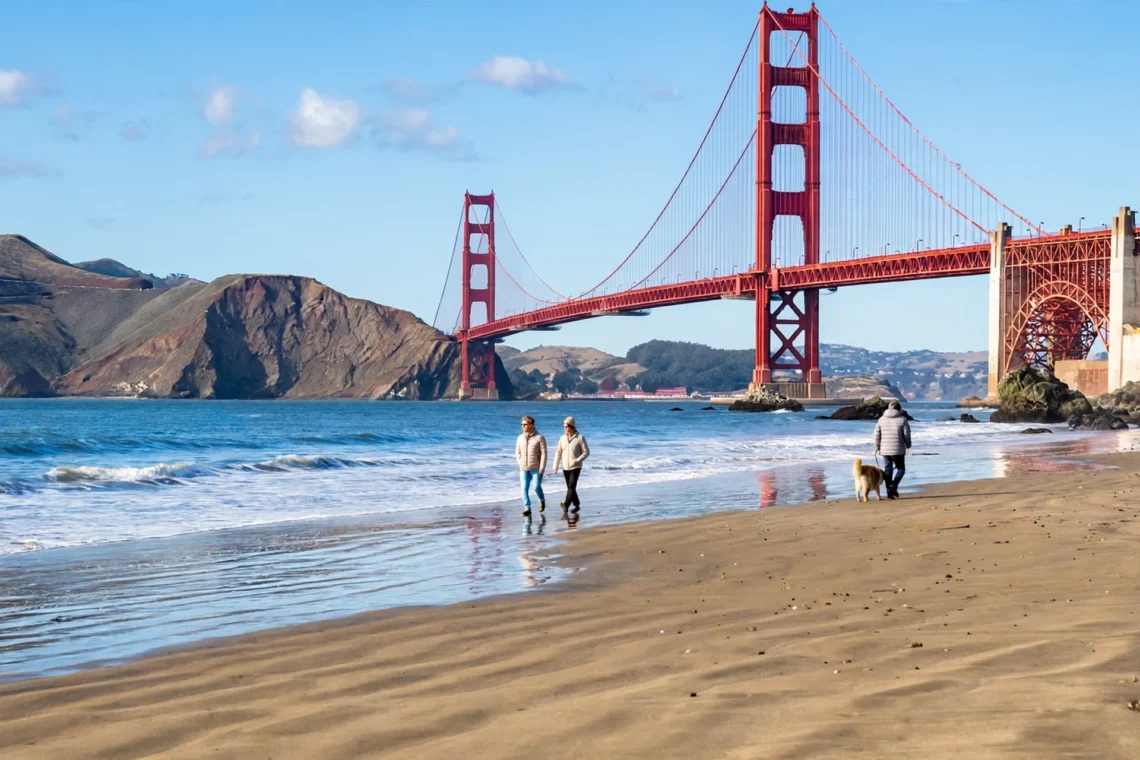
San Francisco has some of the most beautiful coastline in California, but its beaches are nothing like the warm swimming beaches of Southern California. Here, the Pacific is cold, the fog rolls in most summer mornings, and the sand sits below dramatic cliffs with the Golden Gate Bridge in the background. These beaches are made for long walks, sunset photos, picnics, and fresh ocean air, not for lying in warm water all afternoon.
That is the first thing to understand before you plan a beach day here. Most San Francisco beaches are not safe for swimming, and the water stays cold all year. Once you know that, you can pick the right beach for your trip and enjoy it for what it actually offers. This guide covers every beach worth visiting, what each one is best for, when to go, and how to plan your day.
Quick Answer
San Francisco’s best beaches are Baker Beach for Golden Gate views, Ocean Beach for walks and bonfires, Crissy Field for families, and Fort Funston for dogs. Swimming is unsafe at most beaches: the water is cold and currents are strong.
Quick-Guide Table
| Beach | Best for | Water & safety |
| Baker Beach | Golden Gate Bridge photos and picnics | Strong rip currents, no swimming |
| Ocean Beach | Long walks, surfing, and sunset bonfires | Rough surf and sneaker waves, no swimming |
| China Beach | Quiet picnic in a sheltered cove | Calm cove, still no lifeguards |
| Crissy Field East Beach | Families with young kids | Calm, shallow bay water |
| Marshall’s Beach | Secluded views and photography | Strong currents, no facilities, no swimming |
| Fort Funston | Off-leash dogs and hang gliders | Strong currents and steep bluff access, no swimming |
| Mile Rock Beach | Tide pooling and wild coast walks | Rocky shore, check the tide |
| Aquatic Park | The one sheltered swim in the city | Cold water, no lifeguards |
Helpful List: Before You Go
- Pack layers and a windproof jacket — the coast stays chilly even on sunny days
- Bring sunscreen, water, and snacks, as shops near the sand are few
- Check the tide before heading down to Mile Rock Beach
- Stay well back from the waterline and never turn your back on the ocean
- Follow the warning signs posted at each beach
- Keep bags and valuables out of sight inside parked cars
San Francisco Beaches At A Glance
San Francisco’s coastline falls into two groups. On the Pacific side, the beaches face the open ocean. They are wide, windy, and wild, with strong currents and cold water. Ocean Beach, Baker Beach, Fort Funston, and Mile Rock Beach all sit on this side. On the bay side, the water is sheltered and much calmer. Crissy Field East Beach and Aquatic Park face the bay, and they are the places to go if you want gentle water or a family-friendly shoreline.
There is no single best beach in San Francisco, because the right choice depends on what you want from your visit. Baker Beach is best for the classic Golden Gate Bridge photo. Ocean Beach is best for a long walk and a sunset bonfire. Crissy Field East Beach is best for young children. Fort Funston is best for dogs. China Beach is best for a quiet picnic. Marshall’s Beach is best for solitude and photography. Use this guide to match the beach to your plans, and you will not be disappointed.
Can You Swim At San Francisco Beaches?
The honest answer is no, not at most of them. The Pacific water off San Francisco stays between 50 and 58 degrees Fahrenheit all year, which is cold enough to shock the body and tire even a strong swimmer quickly. The currents are the bigger danger. Rip currents at Ocean Beach can move as fast as eight feet per second, and sneaker waves can surge much farther up the sand than the waves before them, pulling people off their feet without warning. There are no lifeguards on any San Francisco beach.
The San Francisco Fire Department and the National Park Service both warn people not to enter the water at Ocean Beach, and the same caution applies at Baker Beach, where strong rip currents make swimming unsafe. Most accidents here do not involve swimmers at all. They involve people who were only standing or wading at the water’s edge when a larger wave knocked them down and pulled them out. Keep small children well back from the waterline, never turn your back on the ocean, and treat the Pacific side as scenery, not as a swimming pool.
There is one exception. Aquatic Park, a sheltered cove near Fisherman’s Wharf, is protected by the Municipal Pier, and it is the one place in the city where people actually swim. The water there is still cold and there are still no lifeguards, so it is a place for a short, careful dip rather than a long swim. If swimming is the main thing you want from a beach day, San Francisco is the wrong city for it, and it is better to know that before you arrive than to find out at the water’s edge.
Baker Beach
Baker Beach is the beach most visitors picture when they think of San Francisco. It runs for about a mile along the western edge of the Presidio, and it has the most famous view in the city: the Golden Gate Bridge rising over the sand, with the Marin Headlands across the water. On a clear day, this is one of the best photo spots in San Francisco, and it is worth coming here even if you only stay for half an hour.
The beach is set up well for a relaxed visit. There are picnic tables, grills, and restrooms, and two free parking lots serve the beach. The sand is wide and easy to walk on, and the views stay good all the way along the shore. The northernmost end of the beach is unofficially clothing-optional, which is worth knowing so it does not surprise you.
Swimming here is not safe because of the strong rip currents, so plan to stay on the sand and wade only at the very edge, if at all. Just above the beach sits Battery Chamberlin, an old coastal defense gun emplacement, which adds a small piece of history to the walk. To reach Baker Beach, drive into the Presidio and follow the signs to the parking lots, or walk in from the nearby trails.
Ocean Beach San Francisco
Ocean Beach is the biggest beach in San Francisco, a 3.5-mile stretch of wide, flat sand along the city’s entire western edge, in front of the Sunset District and next to Golden Gate Park. It is the best beach in the city for a long walk or a run, because the sand goes on for miles and the horizon is nothing but ocean.
This is also the city’s surfing beach, but only for experienced surfers in wetsuits. The surf is heavy, the water is frigid, and the currents are dangerous, so it is not a place to learn or to paddle out casually. For everyone else, the pleasures here are simpler: watching the surfers from the sand, flying a kite, and staying for the sunset. On clear evenings, the sun drops straight into the Pacific at the end of the beach, and the whole shoreline turns gold.
Ocean Beach is also the place for a beach bonfire. The beach has designated fire pits, and on many evenings you will see small groups gathered around them with blankets and snacks. If you plan a bonfire, bring your own wood and check the posted rules at the beach, since fires are only allowed in the pits.
Safety matters more here than anywhere else in the city. Rip currents and sneaker waves are a real and regular danger, so stay well back from the waterline and never turn your back on the ocean. Getting here is easy: street parking runs along the Great Highway, and the N-Judah Muni Metro line ends right at the beach.
China Beach, San Francisco
China Beach is a small, sheltered cove tucked below the Sea Cliff neighborhood, just next door to Baker Beach. It is reached by a walk down into the cove, and the rocky headlands on both sides protect it from the wind that hits the open Pacific beaches. That shelter, plus its small size, makes it one of the quietest beaches in the city, and a good choice when you want a calm picnic rather than a long walk.
The beach has a picnic terrace, restrooms, and a small dedicated parking lot, so it is easy to settle in for an hour or two. The Golden Gate Bridge is visible from the sand, framed by the cliffs, and the view is lovely without the crowds of Baker Beach. At low tide, the rocks at the edges of the cove hold tide pools with mussels and sea anemones, but the rocks are slippery, so step carefully and watch the tide so you are not caught by rising water.
China Beach suits families and anyone who wants a peaceful spot to sit with a book or a picnic. It is too small for long walks or games, and swimming is not recommended, but for a quiet hour by the bay, it is hard to beat.
Crissy Field East Beach
Crissy Field East Beach sits on the bay side of the city, and it is the most family-friendly beach in San Francisco. The water here is calm and shallow at the edges, because the beach faces the sheltered bay rather than the open Pacific. Young children can paddle at the shoreline, and the flat, paved promenade behind the beach is stroller-friendly and easy to walk with a wheelchair.
The views are excellent. Alcatraz sits in the middle of the bay, and the Golden Gate Bridge frames the western end of the beach. There are picnic tables and restrooms, and a free parking lot serves the beach. The wide promenade is popular with walkers, runners, and cyclists, and the beach is also a well-known spot for watching kitesurfers and windsurfers, who use the steady bay wind just offshore.
If you are visiting San Francisco with young kids and want a beach day, start here. It has the easiest access, the calmest water, and the most space to spread out, and it is a short walk from the rest of the Presidio and the Marina District.
Marshall’s Beach
Marshall’s Beach is the most secluded beach in San Francisco, and it sits closer to the Golden Gate Bridge than any other. It is a small cove below the cliffs at the northern end of the Presidio, and it takes some effort to reach. The usual route is the Batteries to Bluffs Trail, a steep path down from the top of the cliffs, and there are no facilities at the beach itself: no restrooms, no picnic tables, and no parking lot.
What you get in return is solitude and some of the best photography angles in the city. The bridge towers directly overhead, the sandstone cliffs rise on both sides, and on a weekday you may have the cove almost to yourself. The beach is also a popular clothing-optional spot, which is worth knowing before you go.
Swimming is out of the question here. The currents are strong, the shore is steep, and there is no help nearby if something goes wrong. Come for the views and the quiet, wear sturdy shoes for the trail, and carry out everything you bring in.
Fort Funston
Fort Funston is the southernmost Pacific beach in San Francisco, set below 200-foot sandstone bluffs on the southwest coast. It is a wild, open place, with dune trails on top of the bluffs, a paved clifftop loop for easy walking, and a long stretch of sand at the bottom. Hang gliders launch from the cliffs on windy days, and watching them ride the updrafts over the ocean is one of the city’s more unusual sights.
This is the best beach in San Francisco for dogs. The beach and much of the surrounding area are off-leash, and on any given day you will see dozens of dogs running on the sand and splashing at the water’s edge. If you are traveling with a dog, this is the beach to choose.
Reaching the sand takes effort. The path down from the clifftop is a steep sandy slope, and the climb back up is just as steep, so wear proper shoes and take your time. There are portable restrooms and picnic tables, and a free parking lot sits at the top of the bluffs. The currents here are strong, so swimming is not safe, and the beach is best enjoyed as a place for walking, watching the hang gliders, and letting the dog run.
Mile Rock Beach And Lands End
Mile Rock Beach is a rugged, rocky cove below the Lands End Trail, and it feels a world away from the city even though it is only a short walk from the trailhead. The beach is best for tide pooling and exploring driftwood along the shore, with views of the Marin Headlands across the water. At low tide, the remains of a shipwreck are exposed on the rocks, which draws photographers and curious walkers.
Getting down takes work. The shore is reached by roughly 250 wooden steps from the trail, and there are no facilities at the bottom. The nearest restrooms are at the Lands End Lookout Visitor Center at the top. Check the tide before you go down, because the beach narrows as the water rises, and the rocks are slippery when wet.
Just along the coast from Mile Rock sit the ruins of the Sutro Baths, a grand swimming complex from the late 1800s that now stands as concrete basins filled with seawater. It is a fascinating place to explore for its history and its views, but it is not a swimming spot. Together, Mile Rock Beach and Lands End make a good half-day outing for walkers who like wild coastline and do not mind stairs.
When To Go: The Best Time To Visit San Francisco Beaches
The best time to visit San Francisco beaches is September and October. These months typically bring the warmest, clearest, and least foggy days of the year, and the beach weather is often better in early fall than in the middle of summer. The water is also at its warmest in September, though it is still cold by any normal standard.
Summer is the foggiest season on the coast. From June through August, a period locals call Fogust, the marine layer often covers the beaches until early afternoon, and some days it never clears at all. The fog usually burns off by late morning on the bay side, while the Pacific beaches can stay grey and windy all day. If you visit in summer, aim for the late morning to early afternoon window, when the sun has the best chance of breaking through.
Whatever the season, dress in layers. Even on a sunny day in the city, the coastal wind and fog keep the beaches chilly, and the temperature can drop quickly when the fog rolls back in. A windproof jacket over a warm layer is the standard San Francisco beach outfit, and it is better to carry a layer you do not need than to be cold on the sand.
Planning Your Beach Day: Parking, Getting There, And What To Pack
Parking varies by beach, so it helps to know the situation before you go. Baker Beach and Crissy Field East Beach both have free parking lots, and Fort Funston has a free lot at the top of the bluffs. China Beach has a small dedicated lot that fills up on good days. Ocean Beach relies on street parking along the Great Highway, which is usually available if you are willing to walk a short distance. Arrive earlier in the day for the easiest parking, especially on sunny weekends.
Public transport works well for some beaches and less well for others. The N-Judah Muni Metro line ends right at Ocean Beach, which makes it the easiest beach to reach without a car. Baker Beach, China Beach, and Crissy Field are served by buses from downtown and the Marina District, though the walk from the bus stop can be hilly. Fort Funston and Mile Rock Beach are easiest by car.
Pack for the coast, not for a tropical beach. Bring layers and a windproof jacket, sunscreen, water, and snacks, because there are few shops right on the sand. A blanket is useful for sitting on the sand, and a bag for your rubbish keeps the beach clean. One more practical warning: never leave bags or valuables visible inside a parked car at a beach or trailhead lot. Break-ins are common at these lots, so take valuables with you or leave them at your hotel.
Common Mistakes To Avoid At San Francisco Beaches
The most common mistake is planning a swimming day. San Francisco beaches are not swimming beaches, and visitors who arrive with swimsuits and inflatables are usually disappointed, or worse, in danger. Plan for walking, photos, and picnics, and save the swimming for a warmer coast.
The second mistake is getting too close to the water. Sneaker waves can reach much farther up the beach than the waves before them, and the sand at the water’s edge can drop away steeply. Stay well back from the waterline, keep children close, and never turn your back on the ocean, even for a photo.
The third mistake is dressing for the city instead of the coast. Downtown San Francisco can be sunny and warm while the beach is foggy, windy, and cold. Bring layers even if the morning looks clear.
A fourth mistake is confusing nearby beaches with San Francisco beaches. Rodeo Beach, Muir Beach, and Half Moon Bay are all beautiful, but they are outside the city, in Marin County or farther south, and they need a separate trip. Do not plan them as part of a San Francisco beach day unless you have a car and a full day to spare.
Finally, do not assume dogs can run off-leash everywhere. Fort Funston is the main off-leash beach, and parts of Baker Beach allow off-leash dogs as well, but other beaches require a leash. Check the posted signs at each beach before letting your dog off the leash.
Conclusion
San Francisco beaches reward visitors who come with the right expectations. They are not warm swimming beaches, and they were never meant to be. They are places for the Golden Gate Bridge at Baker Beach, a sunset bonfire at Ocean Beach, a quiet picnic at China Beach, a family afternoon at Crissy Field, a run with the dog at Fort Funston, and a wild walk at Lands End.
Pick the beach that matches your trip. If you want the famous view, go to Baker Beach. If you have young children, go to Crissy Field East Beach. If you have a dog, go to Fort Funston. If you want quiet, go to China Beach or Marshall’s Beach. Come in September or October if you can, dress in layers, keep a safe distance from the water, and follow the posted warnings. Do that, and San Francisco’s coastline will give you one of the best days of your trip.
FAQ’s:
Can You Swim At San Francisco Beaches?
No. The water stays between 50 and 58°F all year, rip currents are strong, and there are no lifeguards. Aquatic Park’s sheltered cove is the only place where people swim, and even there the water is cold.
Which San Francisco Beach Is Best For Families?
Crissy Field East Beach. It faces the bay, so the water is calm and shallow at the edges, and the paved promenade is stroller-friendly. There are picnic tables, restrooms, and free parking.
Where Can Dogs Run Off-leash In San Francisco?
Fort Funston is the main off-leash beach, with long sand below the cliffs and dune trails above. Parts of Baker Beach also allow off-leash dogs, but other beaches require a leash.
When Is The Best Time To Visit San Francisco Beaches?
September and October. They are usually the warmest and clearest months, with the least fog. Summer is often foggy on the coast, so fall gives you the best chance of a sunny beach day.
Is There Parking At San Francisco Beaches?
Yes. Baker Beach, Crissy Field East Beach, and Fort Funston have free parking lots. Ocean Beach has street parking along the Great Highway, and China Beach has a small lot that fills up early.
Disclaimer
This guide is for general information only, and beach conditions, parking, and access can change, so please check official travel advice and official sources before you travel. Travel3Ways is an independent travel information website and is not affiliated with any tourism board, airline, hotel, or booking service. Travel3Ways was created only to provide helpful information to visitors and does not engage in paid promotions or advertising.


One comment on “San Francisco Beaches: The Best Shores For Views, Families, Dogs, And Sunset Walks”