Antarctica is the seventh continent — a place with no commercial flights, no public hotels, and no government. And yet more than 100,000 people visit every year. The reason is simple: it is one of the last truly wild places on Earth, and getting there, while expensive and complicated, is entirely possible if you know how it works.
This guide explains how to travel to Antarctica from start to finish: how to get there by cruise or by plane, what it costs, when to go, how to choose the right ship, what permits and insurance you need, and how to plan the trip step by step. Prices in this article are ranges only, because they vary by ship, cabin, season, and how far in advance you book — always check current rates before you book. The travel season runs roughly from November to March. And two things worth clearing up at the start: travel to Antarctica is not banned, it is regulated — and the “ice wall” you may have heard about is a misunderstanding, which this article explains below.
Quick Answer
To travel to Antarctica, book an expedition cruise from Ushuaia, Argentina, or a fly-cruise from Punta Arenas, Chile, during the November to March season. You must travel with an IAATO-member operator, and you need evacuation insurance.
Quick-Guide Table
| Trip type | Best places or options | When to go |
| Expedition cruise | Classic Antarctic Peninsula from Ushuaia | November–March |
| Fly-cruise | Punta Arenas to King George Island | November–March |
| Antarctic Circle | Peninsula + Antarctic Circle, 14 days | December–January |
| Wildlife voyage | South Georgia & Falklands | November–March |
| Budget trip | Shoulder-season Peninsula cruise | November or late February–March |
| Scenic fly-over | Sydney, Melbourne, or Perth, Australia | December–February |
Helpful List: Plan Your Antarctica Trip In 6 Steps
- Choose your month — January for first-timers, February for whales, November or March for lower fares.
- Choose your voyage type and ship size — a small expedition ship (100–200 passengers) with IAATO membership.
- Book 12–18 months ahead — popular sailings fill up quickly.
- Book flights with buffer days — arrive in Ushuaia at least two days before departure.
- Confirm your permit is included and buy evacuation insurance that explicitly covers polar evacuation.
- Pack warm layers, waterproofs, sunscreen, and seasickness medicine — and see your doctor before you go.
Can You Travel To Antarctica?
Yes — but only with an organized expedition. Independent travel to Antarctica is not allowed. There is no way to book a flight and a hotel and go on your own, because there are no commercial flights and no public hotels on the continent.
Travel is not banned. Tourism is regulated under the Antarctic Treaty by the International Association of Antarctica Tour Operators, known as IAATO. Antarctica has no government and no permanent residents, so the Treaty system and IAATO set the rules: who can go, where they can land, how many people can be ashore at once, and how the environment must be protected. Only about 98 percent of tourism to Antarctica runs through IAATO operators, and that is by design — the rules exist to protect a genuinely fragile place.
You may also have heard of the “ice wall” — the idea that Antarctica is a giant wall of ice holding back the oceans. That is a flat-earth idea, not a real barrier. Antarctica is a continent, surrounded by the Southern Ocean, and its coast is made of ice shelves and cliffs. Ships and planes reach it every season. What you need as a tourist is simple: an authorized operator, a permit under the Treaty system (which your operator usually arranges), and evacuation insurance.
The Main Ways To Get There
There are four main ways to reach Antarctica, and they suit very different travelers.
Expedition cruise is how most visitors go. Ships sail from Ushuaia, Argentina, across the Drake Passage — about 48 hours each way — and the voyage typically costs from around $5,500 to $25,000 or more per person, depending on the ship, the cabin, and the season. It is the most popular and cost-effective option, though the seas can be rough. A classic Antarctic Peninsula voyage lasts 10 to 12 days.
Fly-cruise is the faster option. You fly from Punta Arenas, Chile, to King George Island in about two hours, then join your ship there. Prices typically run from around $10,000 to $15,000 per person, though some operators start lower. It skips the Drake Passage entirely, which means no seasickness and four extra days, but the flights face frequent weather delays — a flight cannot land in poor conditions, and delays of a day or two happen.
Interior expedition is for specialized adventures. These trips start from Cape Town, South Africa, or Punta Arenas, and reach deep interior camps and the South Pole. They cost $30,000 or more per person and are only for a small number of travelers.
Scenic fly-over is the only option with no sailing and no overnight stays. Flights from Sydney, Melbourne, or Perth in Australia take about 12 hours round-trip and cost roughly $900 to $7,500. You see Antarctica from the air, but there are no landings on the ice. It is a real way to see the continent, but it is not the same as setting foot on it.
How To Travel To Antarctica From The Usa
For travelers from the United States, the journey starts with a flight to South America. You fly to Buenos Aires in Argentina or Santiago in Chile, then take a domestic connection to Ushuaia or Punta Arenas.
Ushuaia is the main gateway. It sits at the southern tip of Argentina, it is the world’s southernmost city, and more than 90 percent of trips to Antarctica depart from here. Punta Arenas in Chile is the other gateway, used mainly for fly-cruises. From Ushuaia, the Antarctic Peninsula lies about 1,000 kilometers to the south, across the Drake Passage.
Build in buffer days. Arrive in Ushuaia at least two days before your departure date, and fly in one or two days early to protect against flight delays. A delayed flight that makes you miss your ship is the most expensive mistake in Antarctic travel, and it is entirely avoidable.
For US travelers, check your passport validity and the entry requirements for Argentina and Chile before you book. You do not need a visa for Antarctica itself, but you may need one for the country you leave from, and your passport should be valid well beyond your return date.
How To Get To Antarctica By Plane
There are no direct commercial flights to Antarctica. The only way to fly there is on a charter flight, and even then, the plane is only part of the journey.
On a fly-cruise, a charter flight takes you from Punta Arenas to King George Island in about two hours, where you join your expedition ship. Operators including Quark Expeditions, Antarctica21, Lindblad Expeditions, and Aurora Expeditions run these flights. The flight removes four days of sailing and the seasickness that comes with it, but it introduces weather-delay risk: the flight cannot land in poor conditions, and delays of a day or two happen. That is why buffer days matter even more on a fly-cruise.
Interior flights use ski-planes to reach ice-strip runways and the South Pole, but these are only for specialized expeditions. And one thing to remember: the plane only skips the Drake Passage. To actually land on the continent, you still need a ship or a land camp. Flying gets you there faster, but it does not replace the expedition itself.
When To Go — The Antarctic Season
You do not get to choose a year-round option, because there is not one. Tourism runs only during the austral summer, roughly from November to March. Outside that window, the sea ice seals the continent off and no ships sail.
Within the season, the months differ a lot. November is early season: the continent is freshly snow-covered, penguin colonies are forming and courtship is underway, and ships encounter pack ice that closes off some sites later in the season. It is quieter, with lower fares.
December brings long days and warming temperatures, with eggs hatching in the penguin colonies. It is busy, and fares are higher. January is peak season: up to 20 hours of daylight, penguin chicks at their most visible, whale sightings, and the mildest weather — with the highest fares to match.
February offers the warmest seas and the best whale watching, as humpback and minke whales have been feeding heavily and are highly active. Penguin chicks are fledging, crowds are easing, and prices are often better. March is the end of the season: cooler, with sea ice starting to reform, dense whale feeding, and the quietest ships and late-season deals.
For first-time visitors who want good weather, peak wildlife, and maximum daylight, January is the single best month. December is a close second and usually commands a premium over January fares.
How Much Does It Cost?
Antarctica is not a budget destination, and the honest answer to the cost question is a range, not a number. Prices vary enormously by ship, cabin, and season, and different sources give different starting points — so treat every figure here as approximate and check current rates.
By voyage type, a fly-cruise or express trip of 6 to 8 days starts from around $6,000 per person. A classic Antarctic Peninsula voyage of 10 to 12 days starts from around $9,000. A Peninsula and Antarctic Circle voyage of 14 days starts from around $11,000. A South Georgia and Falklands voyage of 18 to 23 days starts from around $15,000. Overall, most voyages cost roughly $6,000 to $20,000 or more per person.
A realistic all-in budget for a 10- to 12-day mid-range Antarctic Peninsula expedition — cruise fare, flights to Ushuaia, gear, tips, and insurance — is $12,000 to $25,000 per person. What the advertised fare usually does not include: round-trip international flights to Buenos Aires and then to Ushuaia, which run roughly $850 to $2,500 per person from North American and European hubs; a connecting domestic flight to Ushuaia, adding roughly $300 to $400 unless your cruise includes it; and recommended tips of about $16 per person per day.
You can save money by travelling in the shoulder season. Early November and late February to March are often cheaper than peak December and January sailings. Last-minute deals on unsold berths do appear, but they are not guaranteed, and they still cost thousands of dollars.
How To Choose The Right Ship
Choosing the right ship matters more than choosing the right cabin. The first thing to check is IAATO membership. IAATO is the International Association of Antarctica Tour Operators, and its members agree to strict rules on landing-site limits, wildlife distances, and biosecurity. If a company is not an IAATO member, walk away.
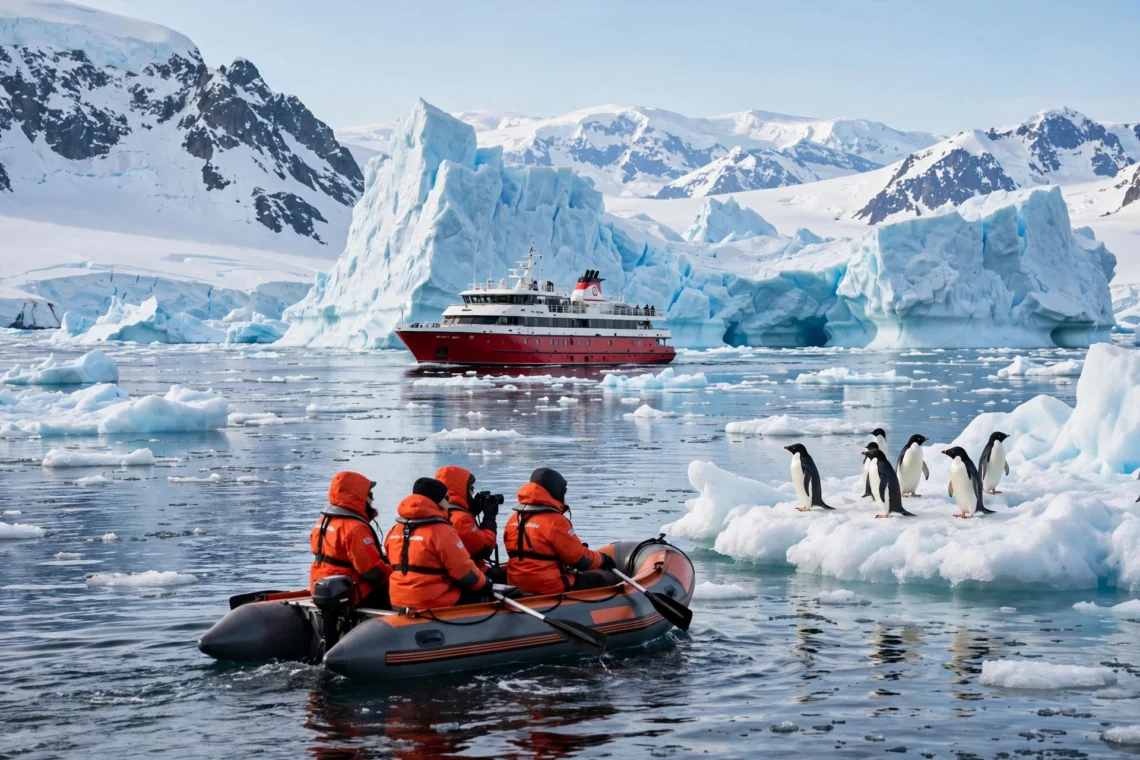
Ship size decides how much time you actually spend on land. Under the Antarctic Treaty system and IAATO rules, no more than 100 passengers may be ashore at any one landing site at a time, and vessels carrying more than 500 passengers may not land people at all. Expedition ships of roughly 100 to 200 passengers land everyone, repeatedly — usually twice a day in inflatable Zodiac boats. Ships of 200 to 500 passengers land in rotation, so each passenger gets fewer or shorter landings. Large ships over 500 passengers are cruise-by only: you see Antarctica through a window and never set foot on it.
There must also be at least one guide for every 20 visitors on shore, with more where a site calls for it. Before you book, check the ship’s capacity, how many landings per day are planned, what the cabin includes, and whether the fare covers the things you need. And remember the warning that catches many first-time travelers: a “cruise to Antarctica” on a large ship is a scenic sail past the peninsula with no landings whatsoever. Check the capacity before anything else.
Permits, Visas, And Insurance
You do not need a visa for Antarctica itself, though you may need one for the country you leave from, usually Argentina or Chile. What matters is authorization under the Antarctic Treaty system: tourists require an appropriate permit from a Treaty Party, and for passengers on an organized trip, the tour operator usually arranges this. You should confirm with your operator that the permit is included before you book.
Insurance is not optional. You need comprehensive medical and evacuation insurance, and the evacuation cover is the critical part. Antarctica is one of the most remote places on Earth, and a medical evacuation can exceed $100,000. Check that your policy explicitly covers polar evacuation, not just general medical care.
Biosecurity is strict, and it starts before your first landing. All outer clothing, bags, and boots are vacuumed and inspected before the first landing. Velcro and turn-ups are checked for seeds, so no foreign seeds or microbes hitch a ride to the continent. Follow the expedition team’s instructions exactly — these rules protect a genuinely fragile place.
On shore, follow your guides’ instructions on wildlife distances. Penguins, seals, and whales are wild animals, and the rules about how close you can go exist for their protection and yours. The guides know the sites, and their word is final.
Can You Go To Antarctica For Free — Or As A Scientist?
The honest answer for tourists is no. There is no free way to visit Antarctica as a tourist. The cruise, the flights, and the insurance all cost money, and there is no budget route that makes the trip free.
The nearest thing to free is working there. National Antarctic programs, such as the US Antarctic Program, hire researchers and support staff — cooks, mechanics, medics, and many other roles — for months at a time. These jobs are competitive, they need months of commitment, and they are real work in an extreme environment, not a holiday. But they are the realistic way to reach Antarctica without paying for a cruise.
Going as a scientist works the same way. You go through a research institution or a national program, with a university or research body behind you. A tourist trip does not let you do research, and you cannot simply show up and join a science station.
A few people reach Antarctica as expedition staff on cruise ships — guides, lecturers, and photographers — but those roles need experience and qualifications. And last-minute deals on unsold berths do appear from time to time, at a discount. They are not free, and they are not guaranteed, but they are the closest a tourist gets to a bargain.
What Happens If You Go To Antarctica Without Permission?
Going to Antarctica without permission is not allowed. Under the Antarctic Treaty, every visitor needs an authorized operator and a permit from a Treaty Party. Travelling without one can lead to fines and legal action, and an operator that breaks the rules risks its permit and its IAATO membership. You could also be sent back.
The rules are strict because the environment is fragile. An unauthorized landing can damage wildlife colonies and bring in foreign seeds or microbes that do not belong there. That is why biosecurity checks, landing limits, and guide ratios exist — and why they are enforced.
In practice, you could not go alone even if you wanted to. There is no commercial transport, no hotel, and no facilities for independent travelers. The only way to reach the continent is with an authorized expedition, and that is the way the system is designed to work.
How To Plan Your Trip Step By Step
Start by choosing your travel window. Think about what matters most to you — penguin chicks in December and January, whales in February, lower prices in November and March — and pick your month from there. Then choose your voyage type and ship size: a classic Peninsula cruise on a small expedition ship is the best all-rounder for first-timers.
Book 12 to 18 months before your intended departure date. That is the standard industry recommendation, and popular sailings fill up quickly. The earlier you book, the more choice you have over cabins and departure dates.
Book your flights with buffer days. Fly to Buenos Aires or Santiago, then take a domestic connection to Ushuaia or Punta Arenas, and arrive at least one or two days early. Build in at least two days in Ushuaia before your departure date.
Arrange your permits and insurance next. Confirm with your operator that the permit is included, and check that your insurance covers polar medical evacuation. Then pack: warm layers, waterproofs, sunscreen, and seasickness medicine. Expedition boots are usually provided by the ship, but check what is included. Finally, see your doctor before you go — Antarctica is remote, medical facilities are limited, and you need to be fit enough for the trip.
Common Mistakes To Avoid
The most expensive mistake is booking a large ship and expecting landings. Ships carrying more than 500 passengers cannot land anyone at all. Check the ship’s capacity before you book, not after.
Not building in buffer days is the second mistake. Flight delays are common on the way to Ushuaia, and a missed ship means a missed trip. Arrive early.
Skipping evacuation insurance is a serious mistake. A medical evacuation can exceed $100,000, and a policy that does not explicitly cover polar evacuation may not pay. Read the fine print.
Ignoring biosecurity is another mistake. Boots and gear must be cleaned and inspected before landings, and the rules are there for a reason. Follow them.
Expecting fixed prices is a mistake too. Fares depend on the ship, the cabin, the season, and how far in advance you book, and different sources quote different starting points. Treat every price as a range and check current rates.
Finally, do not underestimate the Drake Passage. It is four days of your trip — two each way — across some of the roughest water on Earth. Bring seasickness medicine, or choose a fly-cruise if the crossing worries you.
Conclusion
Antarctica is possible to visit — but only the right way. You go with an organized expedition, in the November to March season, from Ushuaia or Punta Arenas. You choose a voyage type that fits your budget and your time, you check the ship size and the IAATO membership, and you book 12 to 18 months ahead.
The practical reminders are simple: build in buffer days, buy evacuation insurance, follow the biosecurity rules, and treat every price as a range. Do that, and the seventh continent — its penguins, its whales, its ice, and its silence — is within reach.
FAQ’s:
Is Travel To Antarctica Banned?
No, travel to Antarctica is not banned. Tourism is regulated under the Antarctic Treaty by IAATO, and you must travel with an authorized operator. Independent travel is not allowed, and every visitor needs a permit arranged through their operator.
How Much Does It Cost To Travel To Antarctica?
Most voyages cost roughly $6,000 to $20,000 or more per person, depending on the ship, cabin, and season. A realistic all-in mid-range budget is $12,000 to $25,000, including flights to Ushuaia, gear, tips, and insurance.
Can You Go To Antarctica For Free?
No, there is no free way for tourists to visit Antarctica. The nearest options are working for a national Antarctic program or as expedition staff, which need qualifications and months of commitment — not a holiday.
Do I Need A Visa To Visit Antarctica?
You do not need a visa for Antarctica itself, but you need a permit under the Antarctic Treaty, which your tour operator usually arranges. You may need a visa for Argentina or Chile, the countries you travel through.
What Is The Best Month To Visit Antarctica?
January is the best month for most first-time visitors, with up to 20 hours of daylight, penguin chicks, and whale sightings. December is a close second, while February offers the best whale watching and lower fares.
Disclaimer
The content is for general information only. Travel conditions, prices, entry requirements, and opening times can change, so please check official travel advice and official sources before you travel. Travel3Ways is an independent travel information website and is not affiliated with any tourism board, airline, hotel, or booking service. Travel3Ways was created only to provide helpful information to visitors and does not engage in paid promotions or advertising.