
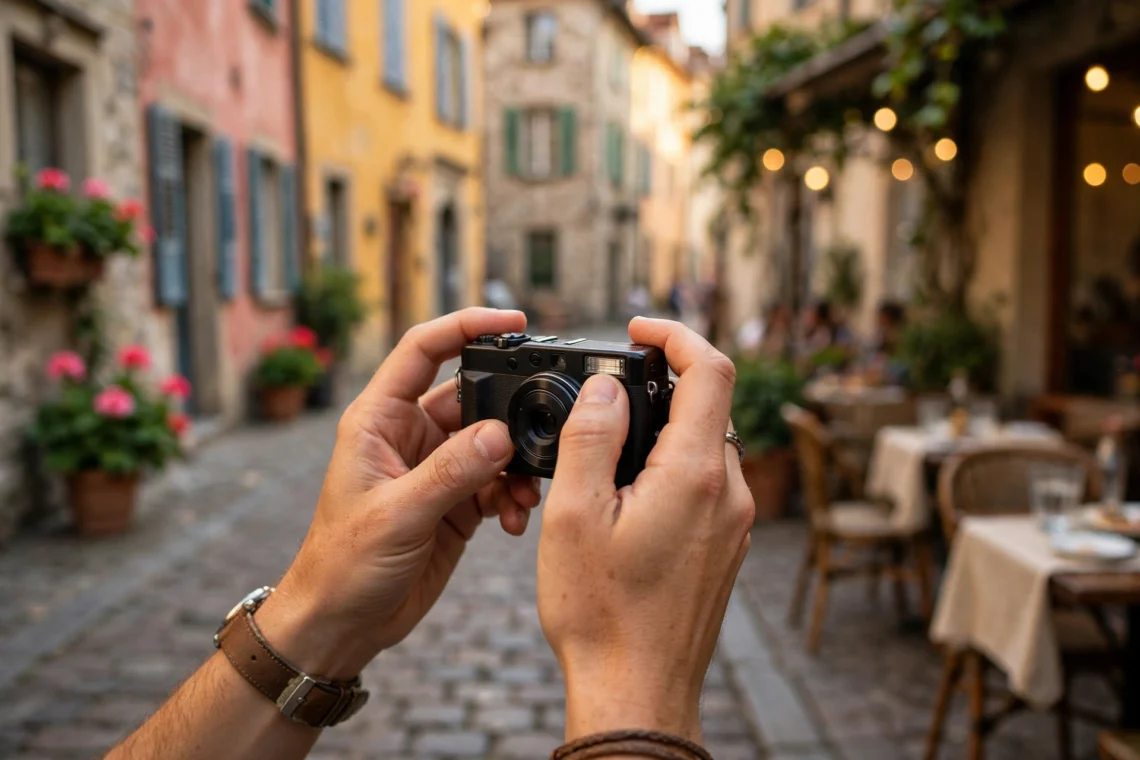
A phone is convenient, but a big camera stays in the hotel. That is the real problem with travel photography: the camera that takes the best photos is useless if it is too heavy to carry from breakfast through dinner. The best small camera for travel is the one that fits in your pocket or your daypack, comes out in seconds, and still takes photos that are clearly better than a phone.
This guide compares the strongest small cameras by what travelers actually need — zoom, image quality, pocket size, video and budget. It starts with the criteria that matter, then picks the best camera for each use, and ends with a five-step guide to choosing your own. This is a research-based guide, not hands-on testing, and prices and stock change often — check the manufacturer’s official website or an authorized retailer before you buy.
Quick Answer
The best small camera for travel is the Sony RX100 VII for most travelers, the Fujifilm X100VI for image quality, and the Ricoh GR IV for true pocket size. Choose by sensor, zoom and how you travel, not by megapixels alone.
Quick-Guide Table
| Trip type | Best camera options | Best for |
| City and sightseeing | Sony RX100 VII, Fujifilm X100VI | One camera for everything |
| Street and candid | Ricoh GR IV, Ricoh GR IIIx | Pocket size, discreet shooting |
| Vlogging and video | Canon G7X Mark III, Sony ZV-1 II, Canon PowerShot V1 | Flip screen, face-tracking autofocus |
| Beach and adventure | OM System Tough TG-7 | Waterproof to 15m, shockproof |
| Budget trip | Kodak PixPro FZ55, used Sony RX100 III or IV | Low cost, real camera quality |
Helpful List: Choose The Right Small Camera In 5 Steps
- List how you travel: cities or nature, photos or video, pocket or bag
- Set a budget range, then add $50–$100 for a spare battery, fast SD card and case
- Compare sensor size and zoom range, not megapixels alone
- Check current price and stock on the manufacturer’s official website or an authorized retailer
- Try it in hand if you can — size and controls matter more than specs on paper
What Makes A Small Camera Good For Travel?
Sensor size matters more than megapixels. A 20-megapixel camera with a 1-inch sensor will beat a 48-megapixel phone in real image quality, because the sensor itself is several times larger and gathers far more light. For travel, a 1-inch sensor is the minimum worth paying for; an APS-C sensor is better again, especially in low light and indoors.
Size and weight decide whether the camera actually leaves the hotel. There are three useful sizes: truly pocketable (fits in a jeans pocket, under 300g), coat pocket (fits in a jacket, around 500g), and shoulder strap (small, but needs a bag or a strap). Be honest about which one you will carry all day, because a camera you leave behind takes no photos at all.
Fixed lens versus zoom is the biggest trade-off. A fixed-lens camera gives you better image quality in a smaller body and forces you to move your feet, which often makes better photos. A zoom camera covers wide landscapes and distant details with one body and no lens changes, which suits unpredictable trips. Neither is wrong — it depends on how you shoot.
Fast autofocus matters when the moment is brief: a street scene, a child laughing, a bird taking off. Image stabilization helps in low light and for video. RAW shooting matters if you edit your photos at all, because a JPEG-only camera limits what you can fix later. Wi-Fi lets you move photos to your phone for sharing on the road.
Battery life is the practical detail most buyers ignore. Manufacturer figures are optimistic — they are measured under ideal conditions — so cut them in half for real travel use. The Sony RX100 VII, for example, is rated at around 220 to 240 shots per charge, which is not enough for a full day of sightseeing. A spare battery is the cheapest useful accessory you can buy.
For video, look for 4K, a flip screen so you can see yourself while filming, and a microphone input or at least a decent built-in mic. Use these criteria to judge any camera, not just the ones listed here — they will tell you more than any single ranking.
Best Overall Small Camera For Travel
The Sony RX100 VII is the strongest all-round choice for most travelers, and it is the camera recommended most often across the sources checked. Its 1-inch 20-megapixel sensor is several times larger than a phone sensor, its 24–200mm zoom covers everything from wide landscapes to distant details, and it has a pop-up electronic viewfinder for bright sunlight. The autofocus is fast and reliable, with real-time tracking that holds focus on a moving subject, and the whole camera fits in a jacket pocket at around 302g.
It does city trips, sightseeing and family holidays better than any other single pocket camera, because it handles nearly everything without changing lenses. You can shoot a wide street scene in the morning, zoom in on a detail across a valley in the afternoon, and film a short 4K clip in the evening with the same camera.
The trade-offs are real. Its sensor is smaller than the APS-C cameras in this guide, so it gives up some low-light quality. The battery is limited at around 220 to 240 shots per charge, so a spare battery is essential. And it is not cheap — expect roughly $1,300 to $1,700 depending on the retailer. Skip it if you want the best low-light quality or the experience of a fixed-lens camera, and look at the Fujifilm or the Ricoh instead.
Best Small Camera For Image Quality
The Fujifilm X100VI is the best small camera for image quality, and it is the one photographers themselves reach for when the photo matters more than the zoom. Its 40-megapixel APS-C sensor sits behind a sharp fixed 23mm f/2 lens, giving a 35mm-equivalent field of view that suits streets, travel and documentary photography. It has 5-axis in-body stabilization, a hybrid viewfinder that switches between optical and electronic, and Fujifilm’s film simulations, which produce vibrant, ready-to-share photos straight out of the camera with little editing on the road.
It suits stills-first travelers who like traditional controls and the discipline of one focal length. The fixed lens means you move your feet instead of zooming, which slows you down in a good way and often produces stronger compositions. The straight-out-of-camera color is a real advantage on a trip, when you do not want to spend evenings editing.
The trade-offs are the fixed lens itself and the size. There is no zoom at all, so distant subjects stay distant. At 521g it fits a coat pocket, not a jeans pocket. And it is often out of stock and selling above its list price, so check availability and the current price before you commit. Skip it if you need zoom or a truly pocketable body.
Best Pocketable Small Camera
The Ricoh GR IV is the clearest pocketable large-sensor choice. It packs a 24-megapixel APS-C sensor into a body of just 262g that slides into a trouser pocket, with a fixed 28mm f/2.8 lens and a fast start-up of under a second. It is the camera for travelers who want DSLR-level image quality in something they will actually carry everywhere.
It suits street and candid photography better than any other camera here, because it is discreet and always with you. The 28mm field of view favors streets, buildings, interiors and environmental portraits, and the camera powers on fast enough to catch a moment that a bigger camera would miss.
The trade-offs are the same as its strengths: no zoom, no viewfinder and no weather sealing. The 28mm lens is wide, so portraits and distant subjects need a different approach. The GR IIIx is the same camera with a 40mm-equivalent lens, which suits travelers who prefer a tighter, more natural field of view. Skip the Ricoh if you want zoom or video-first features, and look at the Sony instead.
Best Small Camera For Travel Vlogging
Travel vlogging needs a different camera from travel photography, and three models stand out. The Canon G7X Mark III remains the easiest premium compact for beginners and creators: a 1-inch sensor, a bright 24–100mm f/1.8–2.8 lens, a flip screen and 4K video, in a body that is simple to pick up and enjoy. It has been the go-to vlogging camera for travel creators for years.
The Sony ZV-1 II is built for solo video creators. Its ultra-wide 18–50mm lens is ideal for arm’s-length filming and narrow interiors, it has a side-flipping touchscreen, a directional three-capsule microphone, and it weighs just 292g. It has no viewfinder and relies on electronic stabilization for video, so it suits creators who film themselves more than photographers who want a viewfinder.
The Canon PowerShot V1 is the strongest video-led option for hybrid use, with a 1.4-type sensor and a 16–50mm lens, designed for travelers who create as much video as photography. What vloggers should check on any camera is the flip screen, the microphone, stabilization, battery life and autofocus that tracks faces. The trade-off with all three is that they priorities video over stills quality and zoom range — they are video cameras first.
Best Budget Compact Camera Under $500
Five hundred dollars buys less in 2026 than it did ten years ago, but there are still good options. At the bottom of the range, the Kodak PixPro FZ55 is basic but a real camera rather than a toy, with a 5x zoom and a price of around $160. The Canon ELPH 360 HS lists at around $380, is small enough to really go in a pocket at 5.2 oz, and its 12x zoom from 25 to 300mm is the lightest way to get real reach — though check stock first, because it has been hard to find at list price.
The smartest budget move is often a used premium compact. A used Sony RX100 III or IV, with the same 1-inch sensor family as the current model, typically sells for $250 to $800 and is still a capable travel camera. When buying used, check the shutter count, the battery health, the lens condition and the seller’s reputation, and buy from a retailer with a returns policy rather than an unknown seller.
Be honest about the limit: under $400, many new compacts barely beat a modern phone. If your budget is tight, a used premium camera or even your phone may serve you better than a new cheap compact.
Best Small Camera For Travel Beginners
Beginners need a camera that is easy to enjoy from the first day: simple auto modes, good JPEG color straight out of the camera, clear menus and light weight. The Canon G7X Mark III and the Sony RX100 VII are the easiest premium starting points, because both work well in auto and grow with you as you learn.
A fixed-lens camera can frustrate a beginner, because no zoom means moving your feet for every shot. That is a skill worth learning, but it is not the easiest way to start. Start simple: learn one focal length, shoot in auto, and move to RAW editing later when you want more control.
A phone is still a fair choice for a first trip. A camera should earn its place in the bag, and if you are not sure you will use it, borrow one or buy used before spending over a thousand dollars on a new compact.
Fixed Lens Vs Zoom: Which Suits Your Trip?
A fixed lens gives you better image quality in a smaller body, simpler shooting and a discipline that often improves your photos. You learn one field of view deeply, and you stop thinking about zoom and start thinking about where to stand. The Fujifilm X100VI and the Ricoh GR IV are the two best examples in this guide.
A zoom gives you one camera that covers wide landscapes and distant details without changing lenses. On a mixed trip — a city in the morning, a mountain viewpoint in the afternoon, wildlife at dusk — a zoom is simply more practical. The Sony RX100 VII and the Panasonic ZS99 are the two best examples here.
City and street trips favor a fixed lens; wildlife, mountains and mixed trips favor a zoom. To decide, think about your last trip’s photos: were they mostly wide scenes and streets, or did you keep wishing you could reach further? There is no wrong answer — the best choice is the one that matches how you shoot, not the one at the top of a ranking.
How To Choose The Right Small Camera In 5 Steps
- List how you travel. Cities or nature, photos or video, pocket or bag — the answer points to a different camera.
- Set a budget range, then add $50 to $100 for a spare battery, a fast SD card and a case. These are not optional extras on a travel day.
- Compare sensor size and zoom range, not megapixels alone. A 20-megapixel 1-inch sensor beats a 48-megapixel phone sensor every time.
- Check current price and stock on the manufacturer’s official website or an authorized retailer, especially for the Fujifilm X100VI and the Ricoh GR IV, which sell out regularly.
- Try it in hand if you can. Size, weight and controls matter more than specs on paper, and a camera that feels wrong in your hand will stay in the hotel.
Common Mistakes To Avoid When Buying A Small Travel Camera
The most common mistake is chasing megapixels instead of sensor size. A bigger megapixel number on a small sensor does not mean better photos — sensor size is what drives low-light performance and image quality.
The second is buying the most expensive camera and leaving it in the hotel. A $2,000 camera that stays in the room takes worse photos than a $500 camera that is in your pocket at sunset. Buy the camera you will carry, not the camera you admire.
Ignoring battery life is another easy mistake. One battery is rarely enough for a full travel day, and a dead camera at golden hour is a wasted opportunity. Trusting one “best” ranking without checking what it suits is equally risky — the top pick for a street photographer may be wrong for a vlogger.
Buying from an unknown seller without checking warranty and returns can turn a bargain into a loss, especially for used cameras. And do not forget the extras: a spare battery, a memory card, a case and a cleaning cloth cost little and save the trip.
Conclusion
The rule is simple: the best small camera for travel is the one you will actually carry. Match the sensor, the zoom and the size to how you travel, and the photos will follow.
For most travelers, the Sony RX100 VII is the most complete choice. For image quality, the Fujifilm X100VI is the pick. For true pocket size, the Ricoh GR IV is the one. For vlogging, the Canon G7X Mark III or the Sony ZV-1 II will serve you best. And for zoom on a budget, the Panasonic ZS99 gives you the most reach for the money.
Check current prices and stock before you buy, and try the camera in hand if you can. Then put it in your pocket, walk out the door, and let it earn its place on the trip. If you want more gear ideas, the site’s other travel gear guides cover hiking poles, lightweight hiking shoes, backpacking packs and luxury travel accessories in the same practical style.
FAQ’s:
What Is The Best Small Camera For Travel In 2026?
The Sony RX100 VII suits most travelers with its 1-inch sensor and 24–200mm zoom, while the Fujifilm X100VI wins on image quality and the Ricoh GR IV on pocket size.
Is A Compact Camera Better Than A Phone For Travel?
Yes, a 1-inch or APS-C sensor gathers far more light than a phone sensor, giving sharper photos, better low-light results and real optical zoom.
Which Small Camera Is Best For Beginners?
The Canon G7X Mark III and Sony RX100 VII are the easiest starting points, with good auto modes, clear menus and strong image quality.
How Much Should I Spend On A Travel Camera?
Budget $250–$800 for a good used premium compact, or $1,300–$1,700 for a new Sony RX100 VII, plus $50–$100 for a spare battery and memory card.
Do I Need A Zoom Lens For Travel Photography?
Not always. A zoom suits mixed trips with distant subjects, while a fixed lens suits city and street photography with better image quality in a smaller body.
Disclaimer
This content is for general information only. Prices, specs, sizes and availability can change, so please check the brand’s official website or an authorized retailer before you buy. Travel3Ways is an independent travel information website and is not affiliated with any gear brand, manufacturer or retailer. Travel3Ways was created only to provide helpful information to visitors and does not engage in paid promotions or advertising.


One comment on “Best Small Camera For Travel: Pocket-size Picks For Every Trip”