
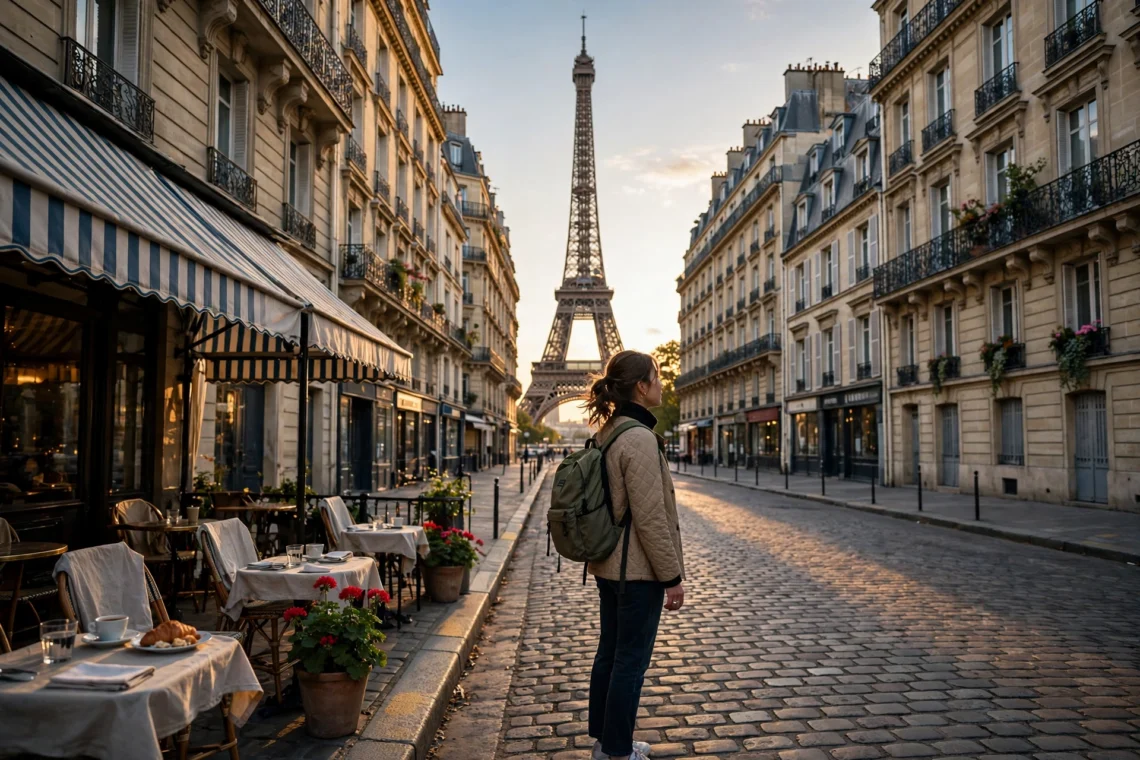
Solo travel to Europe is one of the easiest ways to travel alone anywhere in the world. The cities are compact, the trains are fast, the hostels are social, and eating alone at a café or a tapas bar is completely normal.
You do not need a travel partner to enjoy Europe. You need a plan, a realistic budget, and a few good habits. This guide covers where to go first, how to plan your route, how much it costs, what the entry rules are, and how to stay safe, so that by the end you can plan your first solo trip with confidence.
Quick Answer
Europe is one of the easiest places to travel solo, with safe cities, fast trains, and social hostels. Start in Portugal or Central Europe, base yourself in two to three hubs, and travel in shoulder season.
Quick-Guide Table
| Trip type | Best places or options | When to go |
| First solo trip | Lisbon, Prague, Vienna, Budapest | April–May or September–October |
| Food and nightlife | Madrid, Barcelona, Seville | Spring or autumn |
| Nature and hiking | Ljubljana, Lake Bled, Interlaken | May–September |
| Culture and history | Rome, Florence, Kraków | April–June or September–October |
| Budget trip | Prague, Budapest, Kraków, hostels | Shoulder season, off-peak |
Helpful List: Plan Your First Solo Trip To Europe In 5 Steps
- Pick your style — first-timers start in Portugal or Central Europe.
- Choose 2–3 hubs — stay at least 3 nights per stop, transit under 3 hours.
- Book your stays — social hostels or private rooms, 6–8 weeks ahead in summer.
- Check entry rules — Schengen 90/180 days, EES, and ETIAS status on the official site.
- Pack light and arrive in daylight — keep a zipped crossbody bag in front of you.
Why Europe Is Great For Solo Travel
Europe is built for solo travelers. The distances are short: Paris and Amsterdam, or Vienna and Budapest, are a few hours apart by direct train. You can wake up in one country and have lunch in another.
The transport network is strong. Trains, metros, trams, and buses connect almost every city, and most of the network is easy to use without a car. Hostels, walking tours, and day trips are built around people travelling on their own, so you are never far from company or advice.
Café and restaurant culture makes dining alone easy. In Madrid, people eat tapas standing at the bar. In Lisbon, cafés welcome single diners without a second glance. In Prague, beer halls have long shared tables where strangers sit together. Nobody thinks twice about a table for one.
English is widely spoken, especially in Portugal, the Netherlands, and Scandinavia, and in tourist areas across the continent. That makes it easier to ask for directions, order food, and join a tour on your first day.
Solo travel is thoroughly normalized in Europe. Millions of people travel alone every year, including women travelling solo, and the infrastructure, from female-only hostel dorms to small-group tours, is built for them.
Best Places For A First Solo Trip
Portugal is the easiest first pick. Lisbon is affordable, English-friendly, safe, and full of fellow travelers and nomads. The city is compact enough to walk, the trams are simple, and the hostel scene is exceptional. The Algarve offers coastal trails and cliff walks, and the Rota Vicentina trail suits solo hikers who want scenery without crowds.
Spain suits food lovers and night owls. Madrid eats late, drinks standing up, and stays out in groups that absorb strangers. Barcelona has the beach, the architecture, and the food, though it is busier and more expensive. Seville and Granada offer a slower, warmer side of Spain, with plazas, tapas, and flamenco.
Italy suits art and history lovers. Rome is big and busy, but Florence is compact and acts as a major rail hub for Tuscan day trips, to Siena, Pisa, and the countryside. The Dolomites pair groomed mountain trails with upscale spa hotels, though they are best for travelers who want mountain wellness and are willing to pay for it.
Central Europe is the classic first loop. Prague, Vienna, Budapest, and Kraków are gorgeous, walkable, remarkably cheap, and linked by easy trains. Prague has the Old Town and the castle. Vienna has the coffee houses and the music. Budapest has the thermal baths and the ruin bars. Kraków has the history and the value. Together, they make a two-week trip that is hard to get wrong.
Slovenia suits nature lovers. Ljubljana is a small, safe, walkable capital, and Lake Bled is an easy day trip. Triglav National Park offers alpine hiking and emerald lakes without needing a car, though you will need to book transport for the more remote trails.
Switzerland suits mountain lovers who can pay for it. Interlaken and Zurich have unmatched train punctuality that takes you directly to high-alpine trailheads, with very high safety ratings. It is one of the most expensive solo destinations in Europe, so it suits a short trip or a special occasion, not a long budget run.
Best European Cities For Solo Female Travelers
Solo female travel in Europe is common, and the continent has some of the safest evening walking environments in the world. The Nordic countries lead the way: Copenhagen and Reykjavík have well-lit streets, low harassment culture, and strong public transport after dark. Denmark tops the Women, Peace and Security Index for 2025/26, and Iceland has held the top spot on the Global Peace Index for 19 consecutive years.
Lisbon is among the safest cities in Southern Europe for solo women. It has a warm local culture, a compact center, and low harassment levels by European capital standards. The one place to stay alert is the popular Tram 28 route, where pickpockets target distracted tourists. Keep your bag zipped and in front of you, especially during busy hours.
Vienna is safe, walkable, and easy to navigate alone. The public transport is reliable, the city center is compact, and the café culture welcomes single diners. It suits first-time solo female travelers who want calm and culture.
Prague and Budapest are safe and social, with big hostel scenes and female-only dorms. They suit first-time travelers, though it is still wise to avoid quiet, unlit areas late at night, and to use a taxi or a rideshare rather than walking alone through empty streets.
It is important to be honest about the difference between safety indexes and street experience. National safety indexes reflect overall crime rates. They do not reflect street harassment frequency, which is meaningfully higher in parts of Southern Europe than in Northern Europe. That does not mean Southern Europe is unsafe, but it means a solo female traveler should expect more attention in some places, and should choose her base and her evening plans accordingly.
No city is guaranteed safe for every traveler. Use official travel advice, trust your instincts, and make your own judgement for your situation.
How To Plan Your Solo Trip: Hubs, Pacing And Routes
The best way to plan a first solo trip is to base yourself in two to three walkable hubs connected by direct trains, and build in day trips for outdoor adventures, rather than constantly packing and switching hotels.
Aim for at least three nights per stop, and keep transit days under three hours, so you spend your time exploring rather than in train stations. A slower pace also gives you time to meet people, find your favorite café, and recover from jet lag.
The classic first loop is Central Europe: Prague, then Vienna, then Budapest, over about two weeks. Five walkable cities, all linked by train, with big hostel scenes and lower prices than Western Europe.
The Portugal and Spain loop is Lisbon, then Madrid, then Barcelona. It suits first-timers who want warm weather, food, and nightlife, and it works in ten days to two weeks.
The Italy loop is Rome, then Florence, then Venice. It suits art and history lovers, and Florence makes a good base for Tuscan day trips.
For each hub, plan one day trip. From Lisbon, go to Sintra. From Prague, go to Český Krumlov. From Florence, go to Siena. From Vienna, go to Hallstatt. Day trips give you nature and variety without changing hotels.
Getting Around: Trains, Flights And City Transport
Trains are the solo traveler’s best friend. They run city-center to city-center, with no luggage fees, power sockets, and a rotating cast of seatmates. For distances under four hours, trains are usually faster door-to-door than flying, once you count airport transfers and security.
The Interrail Global Pass is valid in 33 countries, and which pass you can buy, Interrail or Eurail, depends on your country of residence. European residents buy Interrail; non-European residents buy Eurail. Both cover most trains, though some high-speed and night trains need a seat reservation.
Night trains merge a hotel night with a travel day. A couchette costs around €50 to €80, and it removes the late-night-arrival problem, because you wake up at your destination. Book a women-only compartment if you prefer, and keep valuables in your berth, not on the luggage rack.
Budget flights suit the long hops, from Lisbon to Berlin, or from Athens to London. Measure your carry-on carefully, because budget airlines charge steep gate fees for oversized bags. Book early for the best prices, and compare train and flight times with a comparison tool before you decide.
In cities, metros, trams, and bikes are easy to use. In Italy and France, paper regional train and bus tickets must be stamped in a platform validation machine before boarding, or you risk a fine. Digital tickets usually do not need validation, but check the rules for your ticket type.
Where To Stay Alone: Hostels, Hotels And Meeting People
Social hostels are the best solo value in Europe. A dorm bed costs much less than a hotel, and a private room, around €45 to €70, gives you privacy plus a social common room. Most major-city hostels now offer female-only dorms, free walking tours, organized dinners, and co-working spaces. Chains such as Generator, Wombat, MEININGER, A&O, and St Christopher’s Inn have standardized the model, and independent hostels often have the best atmosphere.
Boutique hostels and community hotels offer built-in social connection without sacrificing comfort. They suit solo travelers who want a private room and a social bar, without the dorm experience.
Hotels and apartments offer privacy, but they cost more for one person, because you pay the full room rate. Some hotels charge a single supplement, an extra fee for solo use of a double room. If you want privacy on a budget, a hostel private room is usually better value than a hotel.
Meeting people is easy if you put yourself in the right places. Join the free walking tour on your first day, eat in the hostel common room, join a food tour or a day trip, and say yes to plans in your next city before you arrive. Europe’s hostel network is one of the world’s best solo-social infrastructures, and a solo traveler staying in a well-reviewed social hostel will meet other travelers within an hour and rarely eat a meal alone for the rest of the trip, unless they want to.
Solo dining is normal. Order at the counter, sit at the bar, or take a book to a café. Nobody will think twice.
How Much Does Solo Travel In Europe Cost?
The honest number for a comfortable solo trip, with a private room, real meals, trains, and a paid sight most days, is €100 to €150 a day in Western Europe, €60 to €90 in Central and Eastern Europe, and €150 to €230 in Scandinavia and Switzerland.
Hostel-dorm backpackers can run €40 to €60 a day in the west and €30 to €45 in the east. That covers a dorm bed, supermarket and street food, public transport, and free sights, with one paid activity every few days.
City examples give a clearer picture. Madrid runs €90 to €130 a day. Prague runs €70 to €100. Lisbon runs €80 to €110. Copenhagen runs €140 to €200. Reykjavík runs €160 to €230. These are ranges, not fixed prices, and they change with the season.
To save money, travel in the shoulder seasons, April to May and September to October, when prices are lower and crowds are smaller. Stay in hostels, eat at local lunch spots and markets, use trains for short hops, and take free walking tours. Book accommodation in Western Europe six to eight weeks in advance for summer travel; Eastern Europe allows two to three week lead times.
Entry Rules: Schengen, Ees And Etias
The Schengen Area is a zone of 27 European countries with no routine border controls between member states. For non-EU, non-EEA, and non-Swiss nationals, the core rule is the 90/180-day limit: you can stay in the entire Schengen Area for a maximum of 90 days within any rolling 180-day period for tourism, business, or short visits.
The EU’s Entry/Exit System, or EES, has been fully operational since 10 April 2026. It records non-EU visitors’ names, travel documents, fingerprints, facial images, and the date and place of each entry and exit, replacing passport stamps. Expect biometric registration at the border on your first entry.
ETIAS, the European Travel Information and Authorization System, is a separate pre-travel authorization for visa-exempt visitors, similar to the US ESTA. As of the latest checks, ETIAS is not yet in operation. One source reports a launch in the fourth quarter of 2026, with a fee of €20 and mandatory enforcement around April 2027, after a six-month transition period. Other sources report that, as of October 2026, the system is still not live and the application portal is not yet open. Because the sources disagree, do not rely on a fixed launch date. Confirm the current rules on the European Commission’s official site shortly before you book.
Any website currently accepting ETIAS applications is fraudulent. Only use the official europa.eu/etias domain when the system goes live, and never pay a third-party site for an ETIAS application.
If your nationality requires a visa, you need a Schengen Type C visa before travelling, even for a short visit. That covers citizens of India, China, South Africa, and many other countries. Travel medical insurance, valid for the entire Schengen Area and covering your full stay, with a minimum coverage of €30,000 for medical emergencies, hospitalization, and repatriation, is a standard requirement for a Schengen visa application. Your passport should be issued within the last ten years and valid for at least three months after your departure date.
Staying Safe While Traveling Solo In Europe
Europe is safe for solo travelers, and in most cities it is statistically safer than large parts of North America. The genuine risks are real but specific, and they are overwhelmingly crimes against your wallet, not your person.
Pickpocketing is the actual threat. Government travel advice singles it out for Italy and for Barcelona. The hotspots are predictable: metro lines to major sights, the Trevi Fountain crush, Las Ramblas, any crowded tram. The defense is a routine: phone on a wrist leash or zipped front pocket, one card and a day’s cash in a front pocket, everything else locked at the accommodation, and a bag strap looped around a chair or table leg whenever you sit down.
Keep a zipped crossbody bag in front of you on crowded metros. Schedule daytime arrivals in new cities so you can get your bearings in daylight. Carry a refillable water bottle, and keep a copy of your passport and your insurance details separate from the originals.
Nightlife carries the usual rules: watch your drink, do not accept drinks from strangers, and use a taxi or a rideshare to get home late at night. In Amsterdam, the biggest danger is not crime but bicycles: always check both directions before crossing a cycle lane.
Check official travel advice for each country before you go, and save the local emergency number. In most of the EU, the emergency number is 112. No destination is guaranteed safe, so use official advice and your own judgement.
Solo Travel Europe Group Tours: When To Join One
Group tours suit solo travelers who want built-in company without sacrificing the freedom of travelling alone. They are best for guided hiking, group dinners, and activities where a guide adds value, such as a food tour, a wine tasting, or a mountain trek.
Group tours also solve the single-supplement problem. Many tour operators charge solo travellers extra for a private room, but dedicated solo itineraries often waive that fee or match you with a roommate. That makes a group tour cheaper than booking the same trip alone.
Solo travel suits travelers who want their own pace, their own schedule, and the freedom to change plans. Group tours suit travelers who want structure, company, and a guide to handle the logistics.
Small-group tours are the best of both worlds. Join a day tour or a walking tour in each city, and travel solo between cities. That way you get company when you want it and freedom when you do not.
Common Mistakes To Avoid On Your First Solo Trip
The most common mistake is packing too much into the itinerary. Five sights a day, a new hotel every night, and a transit day every other day will leave you exhausted. Slow down, stay three nights per stop, and leave room for rest.
Another mistake is choosing only the famous cities. Paris, Rome, and Barcelona are wonderful, but they are also crowded and expensive. Mix in a smaller city, such as Ljubljana, Kraków, or Porto, and you will see a different side of Europe.
Do not book flights and hotels before checking entry rules and ETIAS status. The rules change, and a missed requirement can cost you the trip. Check the European Commission’s official site and your own government’s travel advice before you book.
Do not book an expensive hotel when a hostel private room would give you the same privacy, plus a social common room, for half the price. Hostels are not just for backpackers; they are for any solo traveler who wants to meet people.
Do not take pickpocketing lightly. A bag left open on a table, a phone in a back pocket, or a wallet in a back pocket are easy targets. Use a crossbody bag, keep valuables in front of you, and lock the rest at your accommodation.
Do not arrive in a new city late at night. Daytime arrivals let you find your hostel, get your bearings, and settle in before dark. If you must arrive late, book a taxi in advance and let your hostel know.
Conclusion
Europe is the best place in the world to take your first solo trip. It is safe, connected, and full of fellow solo travelers, and eating or wandering alone is completely normal.
Start with Portugal or Central Europe, base yourself in two to three walkable hubs, and travel in the shoulder season for the best balance of weather, prices, and crowds. Check entry rules, ETIAS status, and prices on official sources before you book, and pack light.
A first solo trip builds confidence in a way that few other experiences do. Europe is the perfect place to start.
FAQ’s:
Is Europe Safe For Solo Travel?
Yes, Europe is one of the safest regions for solo travel, with Iceland, Denmark, and Portugal ranking among the most peaceful countries. The main risk is pickpocketing in crowded tourist areas, not violent crime.
What Is The Best Country For A First Solo Trip To Europe?
Portugal is the easiest first pick — affordable, English-friendly, safe, and full of fellow travelers. Spain and Central Europe (Prague, Vienna, Budapest) are close behind, each suiting a different style.
How Much Does Solo Travel In Europe Cost Per Day?
A comfortable solo trip costs €100–150 a day in Western Europe, €60–90 in Central and Eastern Europe, and €150–230 in Scandinavia and Switzerland. Hostel-dorm travelers can spend €40–60 a day in the west.
Do I Need Etias To Travel To Europe?
ETIAS is not yet in operation as of the latest checks, though a launch is reported for late 2026. Confirm the current rules on the European Commission’s official site before you book, and never pay a third-party site.
Where Should A Solo Female Traveler Go In Europe?
Copenhagen and Reykjavík offer the safest evening walking environments, while Lisbon and Vienna are safe and friendly for first-timers. Avoid quiet, unlit areas late at night and use official travel advice.
Disclaimer
This content is for general information only. Travel conditions, prices, entry requirements, and opening times can change, so please check official travel advice and official sources before you travel. Travel3Ways is an independent travel information website and is not affiliated with any tourism board, airline, hotel, or booking service. Travel3Ways was created only to provide helpful information to visitors and does not engage in paid promotions or advertising.


One comment on “Solo Travel To Europe: Best Places, Costs, Safety & First-trip Tips”