Colorado is one of the best hiking states in America. In a single trip, you can walk beside alpine lakes, through red-rock canyons, across wildflower meadows, and up to peaks over 14,000 feet. The variety is the reason so many hikers keep coming back — there is a trail here for every fitness level, every season, and every kind of trip.
This guide groups the best places to hike in Colorado by difficulty, so you can find the right trail for your trip. You will find easy to moderate day hikes, challenging climbs, the best hikes near Denver, waterfall hikes, and long-distance backpacking routes. You will also find the practical planning sections that matter most in Colorado: permits, altitude, and weather safety. Distances and elevation gains in this article are approximate, and permit dates and fees can change, so always check official sources before you travel.
Quick Answer
The best places to hike in Colorado include Emerald Lake and Sky Pond in Rocky Mountain National Park, Crater Lake at Maroon Bells, and Blue Lakes in the San Juans. Choose by difficulty and book permits early.
Quick-Guide Table
| Trip type | Best places or options | When to go |
| Easy day hike | Emerald Lake, Dream Lake, Garden of the Gods | June–September |
| Moderate day hike | Royal Arch, Mount Falcon, Crater Lake at Maroon Bells | June–October |
| Challenging day hike | Sky Pond, Chasm Lake, Mount Bierstadt | July–September |
| Waterfall hike | Alberta Falls, Hanging Lake, Bridal Veil Falls | June–July |
| Denver day trip | Red Rocks Park, Royal Arch, Mount Bierstadt | Year-round; high trails June–October |
| Backpacking | Kenosha Pass, LCW Central Circuit, Conundrum Hot Springs | July–September |
Helpful List: Plan Your First Colorado Hike In 5 Steps
- Pick a trail that matches your fitness level — start with an easy or moderate hike if you are new to altitude.
- Book permits early — Rocky Mountain National Park, Hanging Lake, and Maroon Bells sell out in peak season.
- Spend your first day on a light activity at elevation, and drink 3 to 4 liters of water a day.
- Start early and plan to be below treeline by 2 p.m. to avoid afternoon thunderstorms.
- Pack water, sunscreen, a hat, layers, an offline map, and a power bank — and check trail conditions on official sources before you go.
What Makes Colorado Such A Great Hiking State?
Colorado packs more variety into one state than most countries manage. Alpine lakes sit under jagged granite peaks in Rocky Mountain National Park. Red-rock formations rise out of the ground in Colorado Springs. Wildflower valleys fill the San Juan Mountains in July. Desert canyons and sandstone cliffs line the Front Range. You can hike a gentle lakeside path in the morning and look up at a 14,000-foot summit in the afternoon.
The scale is part of the appeal. According to one source, Colorado has around 39,000 miles of trails across about 24 million acres of public land. That means you are never far from a trailhead, whether you are staying in Denver, Boulder, Aspen, Breckenridge, or a small mountain town like Silverton.
There is something here for every level. Easy lakeside walks suit first-time visitors and families. Moderate climbs reward a half day of effort with a lake or a viewpoint. Hard and expert routes challenge experienced hikers with steep climbs, high altitude, and exposed ridges. The one thing to remember is that popularity does not mean a trail is right for everyone. Always check the difficulty and the altitude before you pick a trail, because a short hike at 10,000 feet can feel much harder than a longer one at sea level.
Easy To Moderate Day Hikes
If you are new to Colorado hiking, or you are hiking with family, start with these trails. They give you the classic Colorado experience — lakes, waterfalls, and mountain views — without an exhausting climb.
Lost Lake is a 2.7-mile out-and-back trail near Nederland, with about 403 feet of elevation gain. The path climbs past waterfalls to a quiet alpine lake, and hikers often spot moose in the area. During peak summer months, a free weekend shuttle runs from Nederland, which makes parking much easier.
Colorado River Trail – La Poudre Pass Trail is a 3.3-mile route in Rocky Mountain National Park, gaining about 594 feet. The trail follows the headwaters of the Colorado River and passes the ruins of an 1880s mining town. It is also one of the better places in the park for moose and bird viewing, and the gentle grade makes it a good first hike at altitude.
Emerald Lake is the classic Rocky Mountain National Park hike. The trail is about 3.6 miles round trip with roughly 770 feet of elevation gain, starting from the Bear Lake corridor. It links three lakes in one walk — Nymph Lake, Dream Lake, and Emerald Lake — with towering alpine peaks above the last one. It is popular, so start early, but it is easy to see why so many people choose it.
Dream Lake and Alberta Falls are two more short, family-friendly options in the same park. Dream Lake is on the way to Emerald Lake and works well as a shorter turnaround point. Alberta Falls is a short walk to a waterfall and is a good choice for a first morning in the park.
Garden of the Gods in Colorado Springs offers easy trails through towering red-rock formations. The paths are mostly flat and well marked, which makes this a good choice for a relaxed walk, for families, or for anyone who wants big views without a big climb. It is also free to visit, which makes it an easy addition to any Colorado Springs trip.
Best Places To Hike In Colorado In Summer
Late June through September is the best time to hike in Colorado. By late June, most high trails are free of snow, summer wildflowers are out, and the days are long. This is when the high alpine lakes and the famous wildflower valleys are at their best.
Sky Pond is one of the best summer day hikes in the state. The trail is about 9 miles round trip with roughly 1,700 feet of elevation gain, and it climbs past Alberta Falls and Timberline Falls to a lake at about 10,900 feet, surrounded by the peaks of the Continental Divide. It is a hard hike, but July through mid-September is the right window for it, when the final approach is clear of snow.
Blue Lakes in the San Juan Mountains is the summer wildflower hike. The trail is about 6.2 miles round trip with roughly 1,600 feet of gain, and in July the meadows below Mount Sneffels fill with wildflowers. The lakes themselves are a striking blue-green, and the trail is hard but manageable for fit hikers.
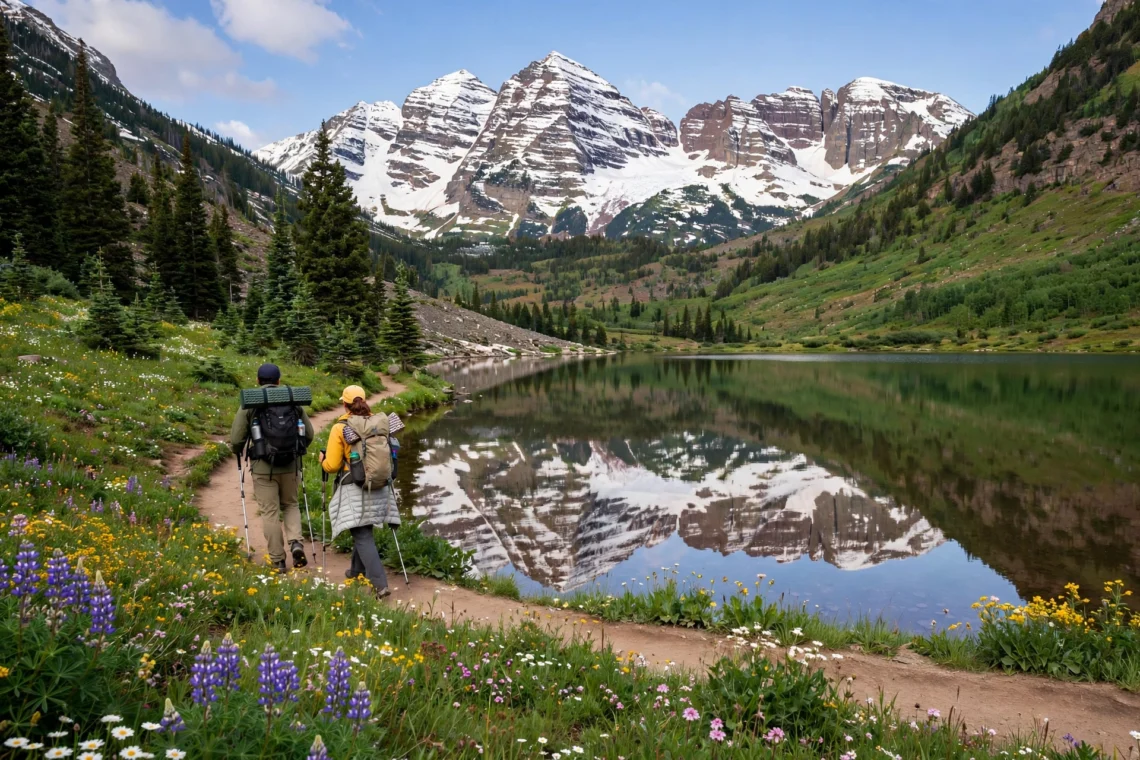
Crater Lake at Maroon Bells is a moderate summer classic near Aspen. The trail is about 3.6 miles round trip with roughly 500 feet of gain, leading to a lake below the Maroon Bells — the most photographed mountains in North America. The best season is June through October, and the lake reflects the twin peaks on calm mornings.
The difference between wildflower season and aspen season matters when you plan. Wildflowers peak in July, while the golden aspens arrive in late September. Both are beautiful, but they are different trips. If you want wildflowers, come in July. If you want golden aspens, come in late September, when the mountains turn gold and the air is cooler.
Summer also brings the one challenge every Colorado hiker must respect: afternoon thunderstorms. Storms build quickly over the high peaks, and lightning is common from June through September. Start early, and plan to be below treeline by 2 p.m. on any exposed route.
Challenging Day Hikes
These trails are for fit, experienced hikers. They are longer, steeper, and higher than the easy hikes above, and they reward the effort with some of the best views in Colorado.
Chasm Lake is a difficult 8.4-mile hike near Longs Peak, gaining about 2,420 feet. The trail climbs above treeline to a dramatic glacial lake framed by sheer granite walls. It is one of the most striking lake hikes in Rocky Mountain National Park, and the final stretch is rocky and exposed, so good footwear and an early start matter.
Hells Hole Trail is an 8.3-mile route in the Mount Blue Sky Wilderness, with about 1,906 feet of elevation gain. The trail follows West Chicago Creek through ancient bristlecone pines and aspen groves, then climbs into a dramatic glacial cirque. It is less crowded than the park trails, which is part of its appeal.
Eldorado Canyon Trail is a steep 6.8-mile out-and-back climb in Eldorado Canyon State Park, gaining about 1,863 feet. Switchbacks climb past towering sandstone cliffs to sweeping views of the Continental Divide, before the trail drops down to South Boulder Creek. It is a demanding climb, but the canyon scenery is unlike anything else near Boulder.
Manitou Incline is short but brutal. The trail is only 0.88 miles up, but it climbs about 2,000 feet over 2,768 steps — an old railway grade turned into a staircase. Most hikers take an hour or more to reach the top, then walk down the Barr Trail. It is a workout, not a walk, and it is best for fit hikers who enjoy a challenge.
Mount Bierstadt is a 7-mile round trip with about 2,850 feet of gain, and it is widely considered the easiest 14er in Colorado. That does not mean it is easy — it is still a hard, high-altitude climb — but the trail is straightforward and well marked, which makes it a popular first 14er. July through early October is the usual season.
Longs Peak via the Keyhole Route is a different level entirely. It is a Class 3 scramble, not a regular hike, with exposed sections like the Narrows. It requires a pre-dawn start, good weather, and real scrambling experience. Most visitors are better served by Sky Pond or Emerald Lake, and that is a sensible choice — Longs Peak is a serious mountain, and it should only be attempted by experienced hikers in good conditions.
Best Hikes Near Denver
You do not need to drive far from Denver to find great hiking. Some of the best hikes near Denver are within two hours of the city, which makes them easy day trips.
Mount Bierstadt is about an hour and a half from Denver and is the most accessible 14er from the city. Manitou Incline is near Colorado Springs, also within two hours, and pairs well with a visit to Garden of the Gods. Royal Arch in Boulder is a moderate climb from Chautauqua Park, with a dramatic sandstone arch framing views of the plains below. Red Rocks Park has short trails weaving between dramatic sandstone formations, perfect for a quick outing. Lake Isabelle near Nederland is a moderate hike to an alpine lake, and Mount Falcon near Morrison offers the Castle Loop, one of the best moderate hikes near Denver.
For the best moderate hikes near Denver, Royal Arch and Mount Falcon Castle Loop are strong choices. Both are challenging enough to feel like a real hike, but they do not require the full day or the altitude of a 14er. They are also easy to reach, which makes them good options if you only have a morning free.
If you want easy walks, the Denver area has plenty. The short trails at Red Rocks Park, the flat paths through Garden of the Gods, and the meadow trails at Boulder’s Chautauqua Park are all good options. These are the best walks near Denver for a relaxed morning, for families, or for a first day at altitude before you attempt something harder.
Waterfall Hikes Near Denver
Colorado’s waterfall hikes are a good choice in early summer, when snowmelt fills the streams, and they are also some of the most rewarding short hikes in the state.
Alberta Falls in Rocky Mountain National Park is a short hike to a powerful waterfall, and it is one of the easiest waterfall hikes in the park. Hanging Lake near Glenwood Springs is a waterfall-fed travertine pool, reached by a steep 2.4-mile climb. The lake is one of the most photographed spots in Colorado, and it requires a timed-entry permit year-round.
Bridal Veil Falls near Telluride is the tallest free-falling waterfall in Colorado. The trail climbs through a box canyon to the falls, and the setting — a dramatic canyon with a waterfall dropping from a cliff — is one of the most striking in the state.
Many of the best hikes near Denver with water are lake hikes rather than waterfall hikes. Emerald Lake, Dream Lake, and Sky Pond all combine lakes and streams with mountain scenery, and the water makes these trails feel alive in a way that dry trails do not. On any hike with water, watch for slippery rocks near streams and waterfalls, and be careful at stream crossings, especially in early summer when water levels are high.
Long-distance And Backpacking Routes
If you want more than a day hike, Colorado has some of the best backpacking in the country. These routes need more planning, more gear, and more time, but they take you into quieter country that day hikers rarely see.
Kenosha Pass Out-and-Back is a 12.1-mile hike along the Colorado Trail, with about 1,532 feet of elevation gain. The trail sits above 10,000 feet, with gently rolling terrain, sweeping views of South Park, and massive golden aspen canopies in autumn. It is a good introduction to longer distances at altitude.
LCW Central Circuit is a 28.8-mile backpacking loop in the Lost Creek Wilderness, with about 4,932 feet of elevation gain. The circuit winds past rounded granite domes, natural arches, and underground streams. It is a multi-day trip that needs real planning, including water, food, and a wilderness permit.
Conundrum Hot Springs is a multi-day hike to natural hot springs in the Maroon Bells-Snowmass Wilderness. It is one of the most popular backpacking destinations in Colorado, and it requires an overnight permit that books up quickly.
Devil’s Causeway is a narrow ridge trail in the Flat Tops Wilderness, and it is only for experienced hikers. The ridge is exposed on both sides, and it should never be attempted in high wind or bad weather.
For any backpacking trip, plan around wilderness permits, Leave No Trace principles, and multi-day logistics. Carry enough water, check water sources before you go, and let someone know your route and your expected return date. Our guide on choosing a good backpacking pack can help with the gear side of the trip.
Best Places To Hike In Colorado Mountains By Area
Colorado’s mountains are grouped into areas, and each area has its own character. Knowing the areas helps you plan a trip around one base instead of driving across the state.
Rocky Mountain National Park and Estes Park is the most popular area, and for good reason. Emerald Lake, Sky Pond, Chasm Lake, and Longs Peak are all here, along with the Bear Lake corridor and Trail Ridge Road. It is the best area for first-time visitors, but it is also the busiest, and it requires a timed-entry permit in peak season.
Aspen and Maroon Bells is the postcard area. Crater Lake and the Maroon Bells Scenic Loop are the main hikes, and the twin peaks reflected in Maroon Lake are the most photographed view in Colorado. The area is best from June through October, and a shuttle or timed parking reservation is required in peak season.
The San Juan Mountains around Silverton and Telluride are wilder and quieter. Blue Lakes, Bridal Veil Falls, and the Cathedral Spires trail are here, and the wildflower meadows in July are among the best in the state. This area suits hikers who want dramatic scenery without the crowds of Rocky Mountain National Park.
The Front Range around Boulder, Colorado Springs, and Denver is the most accessible area. Royal Arch, Garden of the Gods, and the Manitou Incline are all here, and you can hike in the morning and be back in the city for lunch. It is the best area for short trips and for hikers based in Denver.
Breckenridge offers high alpine lakes and accessible 14ers. Mohawk Lakes is a favorite, taking hikers past historic mining ruins to a series of alpine lakes. Quandary Peak is one of the more accessible 14ers in Colorado, and it is a popular choice for a first summit. If you are planning a summit, our guide to the tallest mountains in the US and our guide to the hardest mountains to climb in the world can help you understand what a high-altitude climb involves.
Permits And Reservations You Need To Know
Colorado in 2026 is not Colorado in 2010. Several of the most popular hiking areas now require timed-entry permits or reservations, and arriving without one can mean being turned away.
Rocky Mountain National Park requires a timed-entry permit from late May through mid-October. There are two products: one for the Bear Lake Road corridor and one park-wide, with different entry windows. Both are booked through recreation.gov, and they sell out quickly in summer, so book as early as you can.
Hanging Lake requires a timed-entry permit year-round, booked through the official Hanging Lake site, and the visit includes a mandatory shuttle from Glenwood Springs. Maroon Bells requires a shuttle or timed parking reservation from mid-May through mid-October. The Manitou Incline requires a free reservation, which was added in 2021 and has stayed in place ever since.
At wilderness boundaries like Mount Blue Sky and Lost Creek, free self-issued permits are required. These are simple — you fill out a form at the trailhead — but they are still required, and rangers do check.
One important note: permit dates differ slightly between sources, so this article gives them as ranges, such as late May to mid-October. Always check the official sources — the National Park Service and recreation.gov — for the current dates, times, and fees before your trip.
Altitude And Weather Safety
Altitude is the single biggest safety issue for Colorado hikers. Most mountain trails exceed 9,000 feet in elevation, and the Bear Lake area in Rocky Mountain National Park sits at 9,475 feet. If you are arriving from a low-elevation city, your body needs time to adjust.
Spend your first day at elevation on a light activity before attempting a strenuous hike. A short walk at moderate elevation is ideal. Drink 3 to 4 liters of water per day, starting the day before your hike, and avoid alcohol entirely for the first 24 hours at altitude, since it speeds up dehydration. The symptoms of altitude sickness include headache, nausea, fatigue, dizziness, and shortness of breath, and they typically appear within 6 to 12 hours of arriving at altitude. If your symptoms are severe — confusion, inability to walk a straight line, or persistent vomiting — descend immediately and seek help. Fitness does not prevent altitude illness, and even strong, fit hikers can be affected.
One common misunderstanding is worth clearing up: starting a hike before dawn does not help you acclimatize. Acclimatization takes a day at elevation. An early start does help you avoid the afternoon thunderstorms, which is a good reason on its own — but it is not a substitute for spending a day adjusting to the altitude.
Weather in the mountains changes fast. Summer afternoons bring thunderstorms and lightning from June through September, and exposed ridges and tundra leave you as one of the tallest objects around. Plan to be below treeline by 2 p.m. on any exposed route. Trail Ridge Road can close at any time for weather, even in summer, so check conditions before you drive up.
Leave No Trace matters more in Colorado than in most places, because alpine tundra recovers very slowly from foot traffic. Stay on the trail, do not walk on tundra, and pack out everything you bring in. Keep at least 75 feet from elk and other large animals, as the National Park Service recommends. The emergency number in Rocky Mountain National Park is 911.
How To Plan Your First Colorado Hiking Trip
A little planning goes a long way in Colorado. Follow these steps, and your first trip will be much smoother.
First, choose your level. If you are new to altitude, start with an easy or moderate trail like Emerald Lake or Garden of the Gods, and save the hard hikes for a later day. Then choose your area and season — Rocky Mountain National Park in summer for classic alpine lakes, the San Juans in July for wildflowers, or the Front Range for a trip based in Denver.
Next, book your permits early. Timed-entry permits for Rocky Mountain National Park, Hanging Lake, and Maroon Bells sell out in peak season, and you cannot count on getting one at the gate. Book as soon as your dates are set.
Start early, and prefer weekdays. Popular trailheads fill up by mid-morning, and an early start gives you cooler air, quieter trails, and time to get below treeline before the afternoon storms. Pack water, sunscreen, a hat, layers for changing weather, an offline map, and a power bank. Check trail conditions and the weather forecast on official sources — the National Park Service and recreation.gov — before you head out.
Common Mistakes To Avoid
The most common mistake is hiking a high trail on your first day without acclimatizing. Arriving from sea level and driving straight to a trailhead above 9,000 feet is a reliable way to get altitude sickness. Spend a day at elevation first.
Starting late is the second mistake. Afternoon storms are predictable in summer, and hikers who start at noon often find themselves on exposed ground when lightning arrives. Start early, and be below treeline by 2 p.m.
Not getting a permit is an easy mistake to make, and it can end your day before it starts. Check whether your trail needs a timed-entry permit, a shuttle reservation, or a wilderness permit, and book it in advance.
Overpacking your itinerary is another common error. One big hike per day is enough at altitude. Trying to fit two hard hikes into one day leaves you tired, rushed, and more likely to make mistakes.
Not carrying enough water is a serious mistake. Altitude speeds up dehydration, and many Colorado trails have no reliable water source. Carry more water than you think you need, and drink regularly.
Finally, do not ignore the weather forecast or the trail conditions. Conditions change quickly in the mountains, and a trail that was clear last week can be snowy, muddy, or closed this week. Check the official sources before you go, and be willing to change your plan.
Conclusion
Colorado has a trail for every kind of hiker. Easy lakeside walks like Emerald Lake and Garden of the Gods suit first-time visitors and families. The best hikes near Denver, from Royal Arch to the Manitou Incline, make great day trips from the city. Challenging climbs like Chasm Lake and Mount Bierstadt reward fit hikers with unforgettable views. And multi-day routes like the LCW Central Circuit take experienced backpackers into quiet, wild country.
The key to a good Colorado hiking trip is simple: choose a trail that matches your level, book your permits early, and respect the altitude. Start early, carry plenty of water, get below treeline by 2 p.m., and follow Leave No Trace. Do that, and Colorado will give you one of the best hiking trips you have ever had.
FAQ’s:
What Is The Best Hike In Colorado For Beginners?
Emerald Lake is the best first hike for most visitors. The trail is about 3.6 miles round trip with roughly 770 feet of gain, and it passes three lakes beneath alpine peaks. Start early and book a timed-entry permit.
Do I Need A Permit To Hike In Colorado?
Some of the most popular areas need one. Rocky Mountain National Park requires a timed-entry permit from late May to mid-October, Hanging Lake needs one year-round, and Maroon Bells needs a shuttle or parking reservation. Check official sources.
When Is The Best Time To Hike In Colorado?
Late June through September is the best window for high trails, with snow-free paths and wildflowers in July. Late September brings golden aspens. Winter hiking is possible on low trails, but high routes need snow gear and avalanche awareness.
How Do I Handle The Altitude When Hiking In Colorado?
Spend your first day on a light activity at elevation, drink 3 to 4 liters of water a day, and avoid alcohol for the first 24 hours. If you get a headache, nausea, or dizziness, stop climbing and descend.
Can I Hike In Colorado In Winter?
Yes, on low-elevation trails near Denver and Colorado Springs, such as Garden of the Gods and Red Rocks Park. High trails are usually snow-covered, so snowshoes or skis are needed, and avalanche risk must be checked with official sources first.
Disclaimer
The content is for general information only.Travel conditions, prices, entry requirements, and opening times can change, so please check official travel advice and official sources before you travel.Travel3Ways is an independent travel information website and is not affiliated with any tourism board, airline, hotel, or booking service.Travel3Ways was created only to provide helpful information to visitors and does not engage in paid promotions or advertising.